
The most expensive way to manage your portable storage fleet is often the one where you have the most direct control. If you're currently balancing high senior-level salaries against inconsistent yard flow and operational chaos, you're likely feeling the strain on your margins. Many independent operators find that hiring a full-time operations manager creates a ceiling on growth rather than a floor for stability. Effective outsourced storage operations management provides a way to professionalize your logistics and implement standard operating procedures without the burden of a permanent executive payroll.
This 2026 guide compares the costs, benefits, and practical realities of managing your fleet in-house versus partnering with Portable Storage Pro for fractional operational leadership. We'll examine how shifting to a scalable model can reduce your operating costs and improve revenue per unit while allowing you to focus on strategic growth. By the end of this comparison, you'll have a clear framework to determine which management path aligns with your long-term business objectives and the physical realities of your yard.
Key Takeaways
- Identify the operational ceiling that occurs when daily yard management prevents owners from focusing on high-value customer relationships and strategic expansion.
- Define the specific role of outsourced storage operations management as a fractional leadership resource that provides industry-specific expertise without a full-time executive salary.
- Compare the total cost of ownership for in-house staff against external management to determine which model offers the best flexibility for seasonal peaks.
- Learn the two-step process for transitioning to professionalized operations, beginning with a fleet audit and the documentation of standard operating procedures.
- Discover how the Operating Partner model from Portable Storage Pro creates a scalable business structure that functions efficiently from the yard to the boardroom.
The Operational Ceiling: Why In-House Management Often Stalls Growth
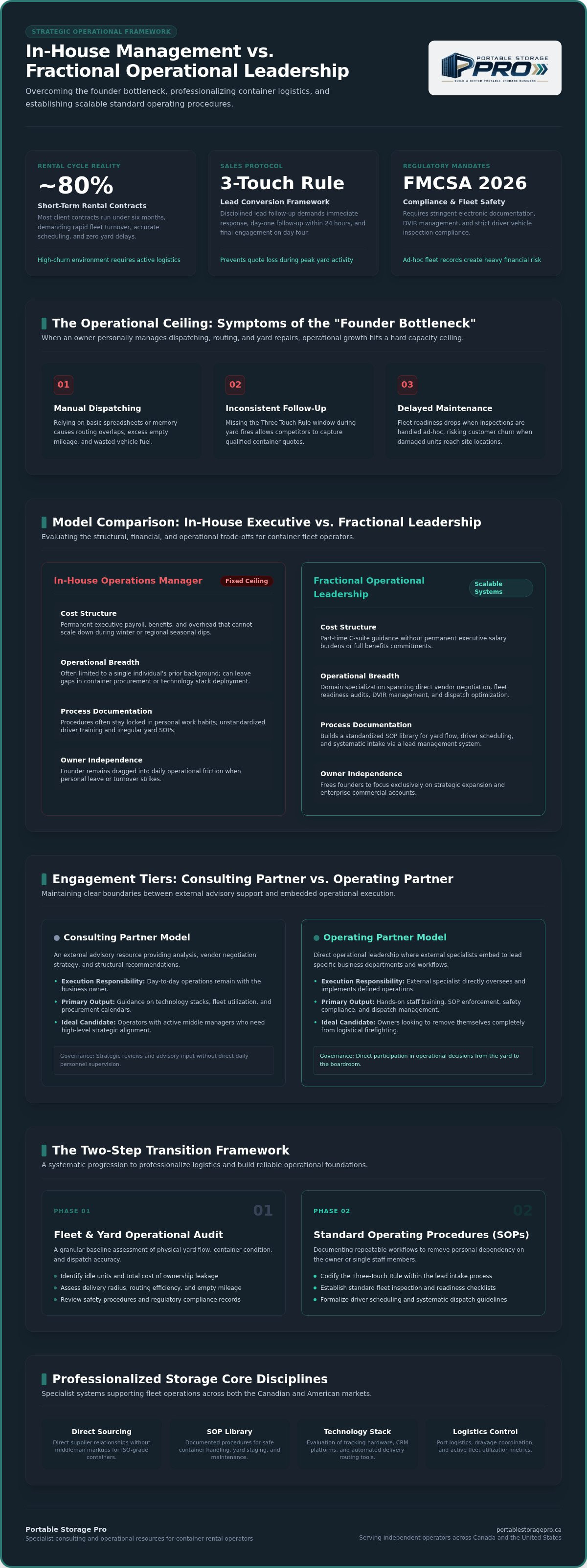
Independent portable storage operators often reach a plateau where the owner's personal capacity dictates the company's growth. This operational ceiling occurs when the transition from a one-man show to a professionalized organization stalls. Instead of focusing on revenue-generating customer relationships, founders find themselves consumed by daily yard fires and logistical minutiae. Managing a fleet in-house without senior-level systems results in hidden costs such as idle containers and inefficient delivery routes. You might realize you have outgrown your current lead management system when inquiries slip through the cracks while you're busy coordinating drayage. Professionalized outsourced storage operations management provides the structure needed to scale without adding permanent high-level payroll.
The "Founder Bottleneck" in Portable Storage
When you personally manage every aspect of yard flow and driver scheduling, your fleet size is capped by your own hours in a day. This "founder bottleneck" creates a reactive business model. Without documented standard operating procedures (SOPs), staff training becomes inconsistent and safety procedures are often overlooked. Lack of oversight in dispatching leads to increased empty mileage and frequent delivery errors, which erode your profit per unit. Consider these common bottlenecks that limit expansion:
- Manual Dispatching: Relying on memory or basic spreadsheets leads to routing overlaps and wasted fuel.
- Inconsistent Lead Follow-up: Missing the Three-Touch Rule window during busy yard days, allowing competitors to capture the quote.
- Delayed Maintenance: Fleet readiness drops when inspections are handled ad-hoc, resulting in damaged units being sent to customers.
The True Cost of In-House Operational Errors
Operational errors are not just inconveniences; they are direct hits to your bottom line. Recent industry data indicates that approximately 80% of portable storage contracts are short-term, meaning under six months. This high churn rate requires constant fleet activity and precise logistics. Poor unit usage means you're paying for yard space and insurance on unrented units that should be generating revenue. Risk mitigation is another critical factor. Ignoring storage business compliance can lead to costly regulatory fines, especially with 2026 FMCSA mandates regarding electronic documentation and DVIR management. "Good enough" logistics might seem cheaper than professionalized outsourced storage operations management, but the total cost of ownership analysis often proves otherwise. Inefficient systems lead to higher customer acquisition costs and lower retention because the service quality is inconsistent.
What is Outsourced Storage Operations Management?
Outsourced storage operations management is a specialized service model that provides independent container rental companies with senior-level executive expertise on a part-time basis. Unlike generic business coaching, which focuses on broad strategy or mindset, this model is deeply technical and rooted in the logistical realities of the portable storage sector. It addresses the granular details of procurement, yard flow, sales conversion, and the integration of specialized technology stacks. This approach allows owners to transition from reactive troubleshooting to a proactive, systems-driven business model.
Portable Storage Pro offers two distinct ways to access this expertise. The Consulting Partner model acts as an advisory resource where the owner retains day-to-day responsibility. In contrast, the Operating Partner model involves the external specialist taking direct operational leadership over defined business areas. This distinction is critical for operators who need someone to not just suggest improvements but to actively implement and manage them. Working with an Operating Partner ensures these systems are managed by specialists who understand the physical demands of a container yard.
Fractional Operational Leadership Explained
Fractional operational leadership allows you to gain C-suite guidance without the financial burden of a full-time executive salary or benefit package. An Operating Partner functions as an extension of your team, participating in daily decision-making and providing structured training for your staff. This leadership is particularly valuable when deploying complex systems like portable storage asset tracking. Having a specialist oversee these deployments ensures that the data generated from GPS or geofencing is actually used to improve fleet utilization and reduce idle time. They bridge the gap between high-level technology and the practicalities of driver scheduling.
Professionalized Logistics and Yard Flow
Professionalized logistics moves your business beyond simple rentals toward a systematic approach to container movement. It involves the creation of a procurement calendar that aligns ordering and delivery dates with seasonal demand peaks in the North American market. This prevents the common issue of having too much capital tied up in idle units or, conversely, losing sales due to inventory shortages. Data-driven management also dictates fleet readiness by tracking damage repairs and maintenance cycles. Instead of guessing when a unit needs service, your leadership team uses specific metrics to ensure every container in the yard is ready for immediate delivery. This level of precision reduces empty mileage and maximizes the revenue generated from every asset in your fleet.
In-House vs. Outsourced Management: A Comparative Analysis
Deciding between an internal hire and outsourced storage operations management requires a clear evaluation of the total cost of ownership. For an independent operator, the choice often comes down to whether you want to manage a person or a system. While an in-house hire offers physical presence, an outsourced partner provides a level of industry-specific expertise that is difficult to find in a single general manager. The ability to scale management resources up or down based on seasonal peaks ensures that you are not overpaying for leadership during slower winter months.
Financial Comparison: Full-Time GM vs. Fractional Partner
Hiring a senior operations leader in Canada involves a significant financial commitment beyond the base salary. You must account for statutory benefits, vacation pay, and the recruitment costs associated with finding specialized talent. A fractional consulting model eliminates these fixed corporate burdens. It replaces them with a predictable engagement fee that provides C-suite guidance without the C-suite payroll. Beyond the direct salary savings, an expert partner brings vendor negotiation strategies that an internal hire might lack. Portable Storage Pro facilitates direct sourcing relationships without middleman markups, which often results in savings that offset the cost of the management engagement itself.
Operational Impact: Skill Sets and Specialization
A single in-house hire rarely possesses expertise across all six core disciplines of the storage business. They might excel at yard flow but lack experience in technology evaluation or lead management. Outsourcing provides access to a team of specialists who understand the granular details of Port logistics and global supply chain risks. This breadth of knowledge is essential for reducing storage operational costs through technical auditing and the enforcement of standard operating procedures. Expert partners can identify inefficiencies in your empty mileage and fleet utilization that an internal manager might overlook while focused on daily troubleshooting.
Speed of implementation is another factor where outsourced storage operations management holds an advantage. An expert partner can deploy documented SOPs and a lead management system in weeks, whereas an internal hire may spend months learning the nuances of the container rental sector. This speed directly impacts your customer acquisition cost. By implementing a disciplined lead follow-up process like the Three-Touch Rule immediately, you improve quote conversion rates and ensure that no revenue is lost to competitors during the transition. This professionalized approach creates a scalable business model that allows the owner to step back from the yard and focus on long-term growth.
How to Transition to Outsourced Operations Management
Moving from a hands-on management style to a systems-led business requires a deliberate transition. You can't simply hand over the keys and expect immediate results. Successful outsourced storage operations management begins with a clear assessment of where your business stands and where the bottlenecks exist. This process involves four primary steps to ensure a seamless integration of fractional leadership.
First, you must conduct a thorough audit of your current fleet and yard efficiency. This provides the baseline data needed to measure future success. Second, you identify the specific core disciplines that require immediate professionalization; whether that is sales conversion or procurement. Third, you define clear boundaries between your responsibilities as the owner and the duties of your operating partner. Finally, you implement standard operating procedures (SOPs) to ensure every task is performed consistently, regardless of who is on-site.
Auditing Your Fleet and Processes
A successful audit looks at your fleet occupancy and revenue per container over the last 12 months. This data reveals your true utilization rates and helps identify units that have been idle for too long. You should also examine your lead intake process to find where inquiries are dropping off. Many operators realize they are losing quotes because they lack a centralized lead management system. Evaluating your technology stack for logistics and billing is equally important. If your software doesn't communicate between the yard and the office, you're likely dealing with duplicate data entry and avoidable errors.
Building Scalable Operating Systems
Once the audit is complete, the focus shifts to building systems that can scale with your fleet. Documenting the Three-Touch Rule for sales follow-up is a priority. This disciplined process ensures that every inquiry receives an immediate response, a 24-hour check-in, and a final follow-up on day four. You also need to establish a vendor reliability assessment for container procurement. This allows you to evaluate suppliers based on their track record for quality and on-time delivery rather than just the initial price. Creating a culture of risk mitigation within your yard team is the final piece. This involves training staff on safety procedures and fleet readiness inspections to prevent damage and liability.
To begin professionalizing your yard flow and sales processes, you can contact Portable Storage Pro to see which level of support fits your current fleet size.
Professionalizing Your Storage Business with Portable Storage Pro
Portable Storage Pro provides a specialized alternative to the high overhead of a full-time operations executive through a "yard to boardroom" philosophy. By accessing expertise across six core disciplines, you can professionalize your logistics without the long-term financial burden of a C-suite salary. This model of outsourced storage operations management ensures that every aspect of the business, from container maintenance to boardroom strategy, is handled with industry-specific competence. It replaces reactive troubleshooting with a disciplined, systems-driven approach that prioritizes tangible outcomes.
The Operating Partner model is particularly effective for owners who have reached their personal capacity. In this arrangement, Portable Storage Pro takes direct operational leadership over defined business areas. This allows you to step away from the daily minutiae of yard flow and driver scheduling to focus on high-level customer growth. By delegating the granular details of fleet management to a specialist, you gain the freedom to build revenue-generating relationships and explore new market opportunities.
The Growth Engagement Model
The Growth Engagement Model is designed to scale alongside your business as your fleet expands. Our partnership provides the resources needed to maintain yard efficiency and sales conversion during periods of rapid growth. We focus on training your team to follow professionalized logistics SOPs, ensuring that your staff can execute complex tasks with minimal owner intervention. This includes improving delivery systems and evaluating your technology stack to ensure every investment decision is backed by accurate data. By refining these operational components, you build a foundation that supports expansion without the typical chaos of a growing yard.
A Better Way to Build Your Business
For independent Canadian operators, accessing a global supply chain is often a significant hurdle. Portable Storage Pro bridges this gap by facilitating direct supplier relationships. Under our consulting model, you receive sourced products without middleman markups, which preserves your margins and improves your total cost of ownership. This procurement strategy, combined with fractional operational leadership, strengthens your competitive positioning against national franchises. You gain the operational sophistication of a large corporation while maintaining the agility of an independent business.
Transitioning to a professionalized management model is a strategic decision that impacts the long-term value of your company. It ensures that your business is not dependent on a single individual but is instead supported by documented systems and expert oversight. If you're ready to move beyond the operational ceiling and build a more profitable fleet, you can begin an operational leadership engagement by visiting the Portable Storage Pro contact page to discuss your specific business goals.
Scaling Your Fleet Beyond the Operational Ceiling
Transitioning to a systems-driven business model is the most effective way to scale your portable storage fleet without adding permanent high-level payroll. Choosing outsourced storage operations management gives you access to senior-level expertise across six core disciplines, from procurement to lead conversion. This approach allows you to implement professionalized logistics and disciplined SOPs that protect your margins and improve fleet activity. It moves you from a reactive state into a position of steady, focused ambition.
Independent North American operators can now access global supply chains through direct supplier relationships with no middleman markups. This ensures your procurement strategy is as competitive as national franchises while you maintain the agility of an independent company. Shifting from reactive yard management to strategic ownership requires a partner who understands the physical and logistical realities of the container sector. You've seen the cost-benefit analysis; now it's time to apply those insights to your specific yard and delivery routes.
If you're ready to move beyond daily troubleshooting and focus on long-term growth, Let’s Talk About Your Business. Building a scalable, professionalized organization starts with the right systems and the right partnership. We're here to help you gain calm control over your complex operational challenges.
Frequently Asked Questions
What is the difference between a Consulting Partner and an Operating Partner?
The Consulting Partner model is an advisory relationship where Portable Storage Pro provides expertise while you retain day-to-day management responsibility. In contrast, the Operating Partner model is a management relationship where our team takes direct responsibility for defined business areas while you retain full ownership. This distinction allows you to choose the level of involvement that fits your growth stage. Both models provide access to senior-level disciplines without the overhead of internal hiring.
How does outsourced management help with container procurement costs?
Outsourced storage operations management reduces procurement costs by providing direct access to global supply chains without middleman markups. Under the consulting sourcing model, we facilitate direct relationships with manufacturers and suppliers, ensuring you pay the actual landed cost. We also implement a procurement calendar to align your orders with seasonal demand peaks. This systematic approach prevents overpaying for last-minute inventory and helps you avoid the hidden fees often found in traditional brokerage models.
Can I still manage my own yard staff if I use outsourced operations management?
Yes, you retain full control over your business and can continue managing your yard staff directly. Our role is to provide the systems, training, and leadership needed to professionalize your logistics and yard flow. Whether you choose the Consulting Partner or Operating Partner model, we work as an extension of your team. We focus on documenting standard operating procedures so your staff can perform tasks consistently and safely without constant owner intervention.
How long does it take to implement professionalized SOPs in my storage business?
Implementing professionalized SOPs generally takes a few weeks when guided by industry specialists, compared to several months for an in-house hire. Because we provide a pre-documented SOP library, the transition focuses on adapting these proven systems to your specific yard layout and fleet size. This speed allows you to see improvements in fleet occupancy and lead conversion much faster than building these processes from scratch or through trial and error.
What technical tools are included in a modern storage business tech stack?
A modern technology stack for a portable storage business includes integrated tools for CRM, logistics, billing, and asset tracking. Key components often include GPS and geofencing for fleet security, alongside temperature and humidity monitoring for climate-controlled units. We also prioritize a robust lead management system to automate the Three-Touch Rule. These tools work together to provide real-time data on fleet readiness and customer usage, enabling better investment decisions for your business.
Do I need to hire a full-time operations manager as my fleet grows?
You don't necessarily need a full-time operations manager to scale your fleet effectively. Outsourced storage operations management offers a way to gain C-suite guidance and professionalized logistics at a fraction of the cost of a senior employee. This fractional model allows you to scale management resources up or down based on your current fleet size and seasonal demand. It eliminates the burden of salary, benefits, and fixed overhead while providing expert oversight for your growth.
How does the Three-Touch Rule improve my sales conversion rates?
The Three-Touch Rule improves conversion by ensuring no inquiry goes cold through a disciplined follow-up sequence. This process requires an immediate response to the initial lead, a check-in within 24 hours, and a final follow-up on day four. In a sector where 80% of contracts are short-term, rapid response is critical. By systematizing this intake process, you ensure that your sales team remains proactive even when the yard is busy with deliveries.
Is outsourced management suitable for operators with fewer than 20 containers?
Operators with smaller fleets often benefit the most from professionalizing their operations early to build a scalable foundation. While some systems are designed for larger organizations, the core principles of procurement, sales conversion, and yard efficiency apply to any fleet size. Implementing these standards early prevents the operational chaos that typically occurs as you grow. Our engagement models are designed to be proportionate to your current resources while providing a clear path for expansion.

Article by
Paul Taylor
Paul Taylor is the founder of Portable Storage Pro, bringing more than 35 years of experience across the container, portable storage and transportation industries. His background spans executive operations, business development, global procurement, sales, marketing and operational improvement in Canada, the UK and international markets.
Paul helps independent portable storage and container rental operators increase revenue, strengthen margins and build more efficient businesses. His work connects strategy with practical implementation, including pricing, delivery operations, supplier sourcing, staff training, technology and customer experience.
His experience includes leading multi-location storage operations and serving on the National Portable Storage Association’s board along with chairing its Canadian committee. Through Portable Storage Pro, Paul shares practical insights to help owners make informed decisions, solve operational challenges and grow profitably.
Disclaimer
Content published by Portable Storage Pro Inc. (PSP) provides general business information and industry insights. It does not replace advice tailored to your business or specialist legal, tax, engineering or other regulated advice. Reading this content or contacting PSP does not, by itself, establish a consulting engagement.
Information reflects circumstances at publication and may change. Examples and potential benefits are illustrative; results depend on individual circumstances, implementation and market conditions and are not guaranteed.
Client services are governed by the signed service agreement, agreed work plan and written amendments. Website and blog content do not amend those terms. PSP’s work is subject to applicable law and the professional commitments set out in its agreement, including the CMC-Canada Code of Professional Conduct and NPSA Code of Conduct and Ethics. Copies are available on request.
Views expressed are PSP’s own. Association membership or references do not imply association endorsement or CMC certification. Nothing in this disclaimer limits PSP’s contractual responsibilities, professional duties or rights that cannot lawfully be excluded.


