
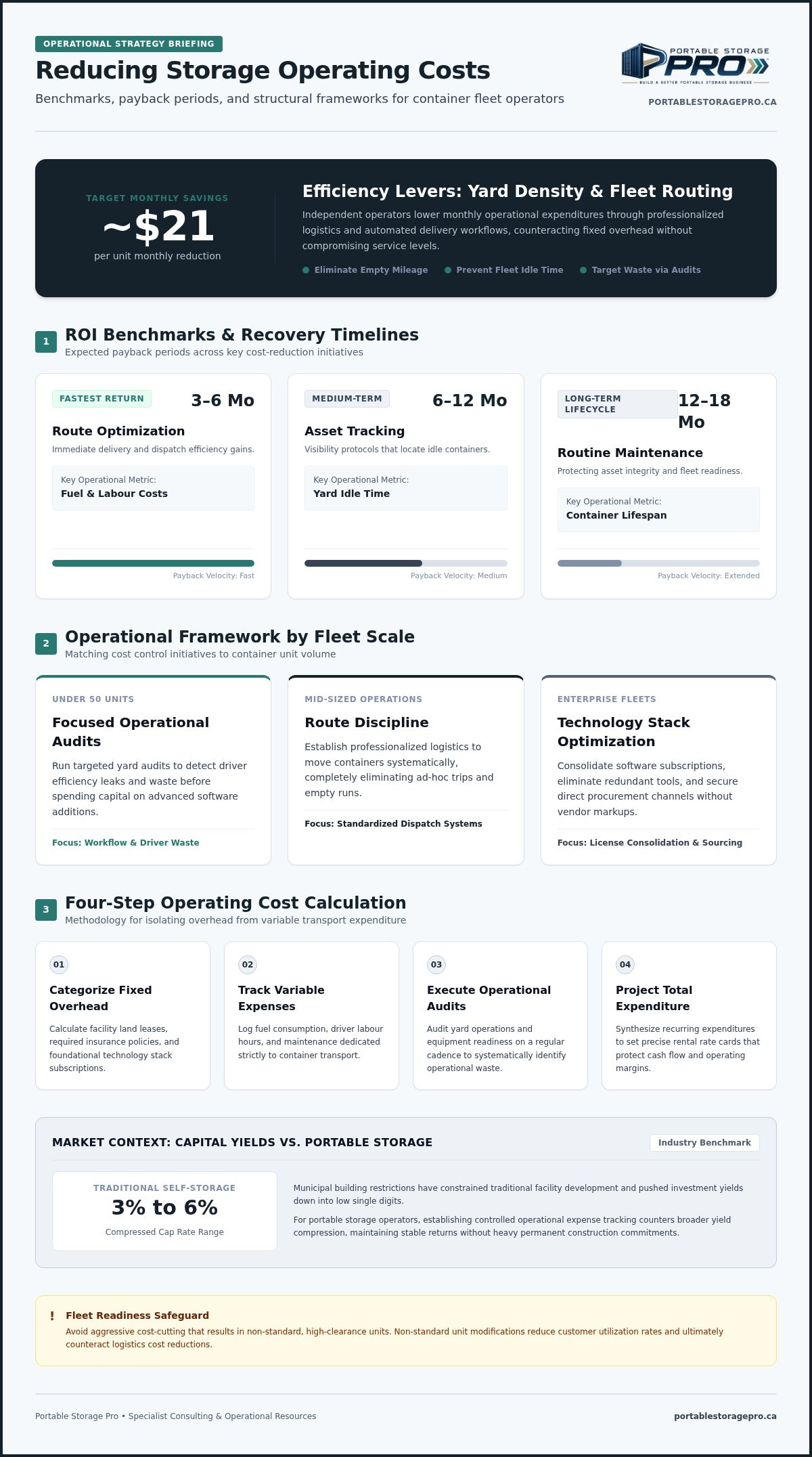
Reducing storage operational costs starts with yard density and fleet routing choices you control day to day. Optimizing those two levers cuts roughly $21 per unit monthly based on recent market research, as independent operators balance fixed facility overhead with automated delivery workflows. You can request a personalized quote to analyze your specific yard layout and fleet requirements.
Key Takeaways: Reducing storage operational costs requires optimizing yard density and fleet routing to cut approximately $21 per unit monthly through professionalized logistics and automated workflows.
- Route optimization delivers the fastest financial impact with a 3–6 month payback period.
- Except when aggressive cost-cutting leads to non-standard, high-clearance units that reduce customer utilization.
- Prioritize technology stack optimization first to consolidate software subscriptions and eliminate redundant license fees.
- The article's ROI table shows routine maintenance takes 12–18 months to recover costs.
Cost-reduction models that match your scale
Scaling a container fleet without matching the operational framework to unit volume erodes margins fast. With clients we see uncalibrated overhead destroy profitability during rapid unit expansion, so the first decision is which tier fits your headcount and distribution.
Typical situations and what works:
- Fleets under fifty units: run focused operational audits (checking for waste) to surface driver efficiency leaks before you add software.
- Mid-sized operations: lock in route discipline so professionalized logistics (moving containers efficiently) replace ad-hoc trips.
- Enterprise fleets: pair technology stack optimization (reducing IT expenses) with direct procurement channels rather than stacked vendor tools.
According to market listings, basic baseline software tracking starts near the monthly per-unit figure cited above, yet physical logistics still need structured intervention. Partnering with Portable Storage gives you specialist guidance for your tier without inflated supplier markups. Audit the workflow first, then add structured software tools that hold the savings in place.
Calculating your operating costs
You only steer the bottom line when fixed facility expenses sit apart from variable transport costs. Building new self storage facilities has become harder and more expensive because many municipalities have restricted new construction, which is why portable storage operators need a clean cost model rather than a blended guess.
- Categorize fixed overhead: Calculate land leases, insurance, and core technology stack optimization.
- Track variable expenses: Log fuel, labor hours, and maintenance spent moving containers efficiently.
- Execute operational audits: Audit yard routines regularly checking for waste.
- Project total expenditure: Combine all recurring expenses to set accurate rental rates.
Detailed financial tracking matters when you follow a 2026 scaling roadmap. Clear expense metrics prevent sudden cash squeezes, and monthly analysis counters the margin pressure caused by municipal building limits.
Sharing insights on the biggerpockets.com thread "From 0 to 84: How I grew my portable self storage business", a contributor wrote:
"That has forced cap rates on self storage facilities to compress to really low levels in the 3% to 6% range in most cases. For those cap rates, you are better off just investing passively in the stock market or buying into another asset class with higher cap rates." (source)
Municipal restrictions limit traditional development and drive capital yields down for standard storage models. Precise overhead figures help you hold solid margins even when market returns compress.
ROI benchmarks and timelines for optimization
Targeted operational adjustments produce measurable payback for independent fleet operators, and deployment speed decides how much of that payback you actually keep.
Asset-tracking work that follows a portable storage tracking guide cuts idle container time and returns cash sooner than a full yard redesign. Industry price sheets list software integrations on a modest monthly per-unit basis, functioning as a filter for hidden profit leaks.
| Cost Reduction Strategy | Expected Payback Period | Key Operational Metric |
|---|---|---|
| Route Optimization | 3–6 Months | Fuel & Labor Costs |
| Asset Tracking | 6–12 Months | Yard Idle Time |
| Routine Maintenance | 12–18 Months | Container Lifespan |
Regular operational audits keep the fleet honest. Professionalized logistics trim labor expense, while technology stack optimization compounds across branches. Choose software upgrades first when you need near-term cash-flow impact, and leave heavy structural yard shifts for later phases.
Strategies for reducing operational costs
High-impact work begins with operational audits across delivery routes, yard logistics, and administrative workflows, because idle fleet movements are the leak operators miss most often.
In consulting engagements we see empty mileage quietly dominate fuel and labor lines. Start with professionalized logistics so empty runs disappear before you buy another tool. Entry-level software appears at low monthly rates in public databases, yet full asset visibility still needs connected systems.
Evaluate your current stack before you purchase anything new. Integrating rental management with dispatch software produces immediate productivity gains; a practical walkthrough sits in this storage tech-stack reference. Beyond software, technology stack optimization depends on physical asset control and route consolidation, which build margin over time rather than in a single invoice cycle.
Request a quote when you want those integrations scoped to your routes and yard map.
Streamline operations with smart yard management
Specialized yard management software lets you automate gate access, track unit locations, and apply technology stack optimization across the facility. According to market listings, basic access modules sit at a low monthly price point.
Off-site portable units need a different control pattern than site-built self-storage. Lien processes, remote access limits, and GPS-backed inventory give you the same non-payment leverage you expect on a fixed site, without relying on a single gate. Yard tools that combine automated GPS tracking with remote access restrictions keep every asset visible.
Manual gate checks slow drivers and inflate labor. Automated gates clear drivers in seconds, and professionalized logistics depend on digital gate logs and real-time inventory maps instead of paper. Operational audits also catch idle software seats you no longer need. Automated yard systems cut manual oversight enough that a single staff member can run an entire facility.
A commenter in the biggerpockets.com thread "From 0 to 84: How I grew my portable self storage business":
"Even better yet, Terry had one person living on the property managing the whole thing for him. Any other facility of this size you would expect employees to be running all over the place, however since it was storage, it only needed one employee to run the whole facility." (source)
That observation matches what automated gates and digital asset tracking deliver: one manager, full site control, lower labor load.
Lower utility costs with peak shaving controls
Automated controls cut utility spend by moving energy-intensive battery charging off high-rate electrical periods. Industrial energy market listings show monitoring hardware at accessible price points for yard operators.
Peak shaving (reducing power use during high-rate periods) uses programmed timers to avoid TOU rate structures (Time-of-Use electricity pricing). Schedule climate-control cycles and heavy charging outside local peak windows so demand spikes, and the demand charges behind them, fall on the month-end bill. Energy management systems shed load without pulling staff off the yard floor.
Heavy container forklifts become peak-time sinks when crews plug them in the moment a shift ends. Automated transfer switches stop concurrent draws, and battery storage can hold off-peak power for later discharge when site load surges. Managing that load profile protects the same operating margin you build through routing and yard density.
When aggressive cost-cutting damages fleet readiness
Cheap, non-standard container units often destroy operational capability faster than they save capital. Ground-clearance shortcuts backfire at once: when units sit too high, customers cannot park vehicles or trailers inside, utilization drops, and satisfaction follows.
From direct client work, low-profile chassis bought without checking door thresholds become useless yard stock. Sacrificing utility for the first invoice drives long-term losses you cannot route around.
Before you purchase modified assets, run operational audits on the site and verify loading angles. High-clearance modifications suit raw material storage; low-profile access fits equipment loading. Retrofits after the fact cost twice as much as buying compliant specs at the start.
To discuss fleet strategy, reach the team through portablestoragepro.ca.
Proven industry practices yield long-term savings
Standardized processes turn one-off wins into fleet-wide savings you can forecast.
From client work, operators who schedule operational audits on a fixed cadence uncover fuel and labor leaks before they become emergency repairs. According to market listings, basic tracking modules land near the same modest monthly per-unit software band already noted in market research, so you protect budget by staying on core yard efficiency instead of optional add-ons.
Professionalized logistics shortens transport distance and removes empty runs, which immediately reduces wear on delivery trucks. Technology stack optimization stops subscription overlap across office tools and keeps fixed overhead predictable.
Ready to lower operating expenses? Contact the advisory team for a fleet operations review.
Direct sourcing cuts procurement overhead
Direct supplier relationships remove middleman markups on fleet expansion and lower capital outlay per unit.
From client work, third-party brokers quietly inflate baseline equipment cost. Sourcing from manufacturers restores control over specifications and keeps procurement free of stacked margins. Operational audits during acquisition protect working capital while you grow.
As members of the National Portable Storage Association and CMC-Canada (the Canadian Association of Management Consultants), Portable Storage Pro supports fleet expansion decisions with managed procurement and no middleman markup. Direct buying fits operators adding multiple units in a single growth cycle.
Tip: Work with standard industry partners to eliminate middleman supplier markups across fleet procurement.
Frequently asked questions
What are some strategies for reducing operational costs?
Strategies for reducing storage operational costs focus on optimizing container delivery routes, improving yard organization, and automating routine fleet management tasks. Efficient routing limits empty mileage and reduces driver overtime during busy rental periods. Regular maintenance schedules prevent costly emergency repairs on tilt-bed trailers and delivery trucks. Improving your fleet layout speeds up loading times, which maximizes daily drop-offs.
How can a company reduce OPEX?
Operators lower operating expenditures by auditing recurring vendor expenses, negotiating direct supplier agreements, and eliminating wasted fuel. Reviewing facility software subscriptions ensures you only pay for tools your team actively uses. Sourcing rental containers directly from manufacturers removes middleman markups and preserves operational capital. Systematic fleet audits help identify idle units that can be relocated to high-demand service areas.
How do I calculate my operating costs?
Calculate your operating costs by adding fixed operational fees to variable delivery and maintenance expenses over a specific billing cycle. Sum up fixed expenses like yard leases, insurance, and core software platform licenses. Add variable expenses including fuel, driver wages, maintenance, and drayage (port-to-yard transport). Divide this total dollar figure by your active fleet size to calculate your cost per container unit.
What are practical ways to reduce IT expenses?
You lower tech spending through technology stack optimization by canceling redundant software subscriptions and consolidating core tools. Market listings place basic tracking tools in a low monthly per-unit band, so dropping unused features frees capital quickly. Integrated management software reduces manual data entry and cuts administrative labor. Regular audits stop unnecessary license renewals across the department.
How can I differentiate variable from fixed costs?
Fixed costs remain constant regardless of rental volume, whereas variable costs change based on your daily container deliveries and service activity. Facility leases, liability insurance, and core management software represent fixed operational obligations. Fuel usage, driver overtime pay, and drayage fees fluctuate directly with customer delivery requests. Identifying these differences helps you make strategic adjustments to protect margins during slow periods.
Next Steps for Cost Control
The same questions that open this guide close it: which cost tier matches your scale, which audits free cash first, and which procurement path keeps markup out of the build. In 2026, lowering overhead still means operational audits across fleet management and procurement, paired with professionalized logistics that remove empty mileage. Those workflow shifts are how you keep reducing storage operational costs without starving fleet readiness. Portable Storage Pro advisers hold professional memberships that support those decisions under a Growth Engagement Model: you retain day-to-day authority while agreed priorities move forward. If you assume the operation is too small for a review, start with a conversation anyway; focused process changes land quickly at modest fleet sizes. Schedule a consult on infrastructure and procurement at Portable Storage Pro Contact.

Article by
Paul Taylor
Paul Taylor is the founder of Portable Storage Pro, bringing more than 35 years of experience across the container, portable storage and transportation industries. His background spans executive operations, business development, global procurement, sales, marketing and operational improvement in Canada, the UK and international markets.
Paul helps independent portable storage and container rental operators increase revenue, strengthen margins and build more efficient businesses. His work connects strategy with practical implementation, including pricing, delivery operations, supplier sourcing, staff training, technology and customer experience.
His experience includes leading multi-location storage operations and serving on the National Portable Storage Association’s board along with chairing its Canadian committee. Through Portable Storage Pro, Paul shares practical insights to help owners make informed decisions, solve operational challenges and grow profitably.
Disclaimer
Content published by Portable Storage Pro Inc. (PSP) provides general business information and industry insights. It does not replace advice tailored to your business or specialist legal, tax, engineering or other regulated advice. Reading this content or contacting PSP does not, by itself, establish a consulting engagement.
Information reflects circumstances at publication and may change. Examples and potential benefits are illustrative; results depend on individual circumstances, implementation and market conditions and are not guaranteed.
Client services are governed by the signed service agreement, agreed work plan and written amendments. Website and blog content do not amend those terms. PSP’s work is subject to applicable law and the professional commitments set out in its agreement, including the CMC-Canada Code of Professional Conduct and NPSA Code of Conduct and Ethics. Copies are available on request.
Views expressed are PSP’s own. Association membership or references do not imply association endorsement or CMC certification. Nothing in this disclaimer limits PSP’s contractual responsibilities, professional duties or rights that cannot lawfully be excluded.


