
Replace manual gate logs with cloud management, smart access, and automated tools (technology stack) and you can target an 18-month payback while you raise facility yield. If your staff still walks the gate with paper codes, your containers sit idle between jobs, or zoning blocks a new building, the decision is which software and yard-automation steps to take first. Portable Storage Pro guides North American operators through software selection, yard automation, and operational changes to scale container fleets efficiently.
Key Takeaways: Modernizing your storage business through digital transformation requires integrating smart access and cloud management to achieve a target 18-month payback on technology investments.
- Target an 18-month payback by replacing manual gate logs with automated technology stacks.
- Avoid digital transformation unless you first fix physical site geometry and entry bottlenecks.
- Deploy mobile storage units to scale revenue without waiting for municipal building permits.
- The 18-month implementation plan in this article details phases for fleet and software optimization.
Digital models that expand your yard without new Building permits
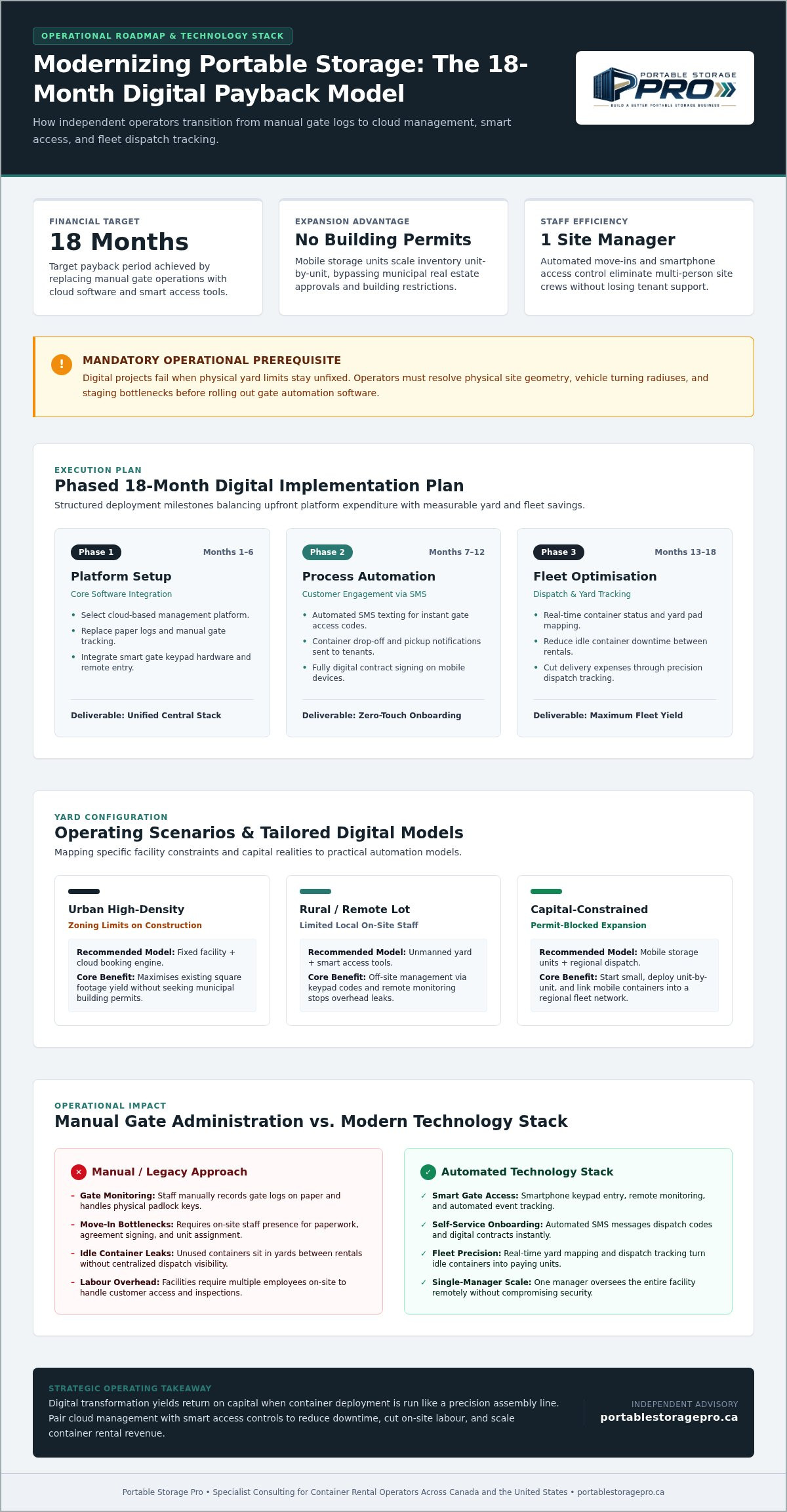
Modern software models let you streamline traditional, hybrid, and unmanned yards. Three situations we see with clients map to clear choices: a high-density urban site with zoning limits fits a fixed facility plus cloud booking; a rural lot with limited staff fits an unmanned yard with automated tools for access; a capital-constrained operator who cannot wait on building permits fits mobile storage units (inventory utilization) managed as a regional fleet.
Traditional self-storage still needs heavy capital and extensive municipal approvals. Expanding physical buildings is often blocked by local zoning boards that limit new construction. Selecting the right model depends on your physical site and capital plan. Fixed facilities fit high-density urban zones. Unmanned remote yards suit rural locations when automated access is in place.
To expand without heavy building permits, deploy mobile storage units and tie them to central software so one yard becomes a flexible regional network. You lower overhead by texting customers (SMS engagement) to automate gate codes, drop-off notifications, and digital contract signing. Scaling that setup needs direct operational guidance. You can build a portable storage business and grow fleet efficiency without excess capital.
Adding mobile containers lets you start small and scale revenue gradually without waiting for municipal building permits.
A commenter in the biggerpockets.com thread "From 0 to 84: How I grew my portable self storage business":
"I thought to myself "wow, with portable units I could start small and build the business one unit at a time."" (source)
That operator path shows how portable container models work around local construction restrictions through unit-by-unit expansion. Digital management plus a flexible fleet gives you a direct route around traditional real estate bottlenecks.
How smart access cuts on-site labor without losing tenant convenience
Self-storage operators modernize by pairing smart access control hardware with central management software. The integration cuts on-site labor while tenants keep convenient access.
When you upgrade your technology stack (automated tools), daily site management becomes a single workflow. Facilities replace physical keys with smartphone keypad access, remote monitoring, and automated move-ins. Those systems remove manual gate checks, speed customer onboarding, and assign units without staff intervention.
Deploying smart gate software reduces administrative overhead across traditional yards and container rental setups. For portable operations, online customer portals plus real-time tracking give off-site clients visibility over their units. Automated access strengthens security while you reduce full-time labor cost. Integrated software supports lean operations that scale without matching headcount growth.
Operators planning broader upgrades can review the 2026 strategic business guide to align fleet strategy with modern software platforms. More on this: Portable Storage.
Reflecting on operational efficiency, a participant in the biggerpockets.com thread "From 0 to 84: How I grew my portable self storage business" noted:
"Even better yet, Terry had one person living on the property managing the whole thing for him. Any other facility of this size you would expect employees to be running all over the place, however since it was storage, it only needed one employee to run the whole facility." (source)
Automated operational technology lets a single manager oversee an entire facility. Digital access controls remove the need for multi-person site teams without sacrificing security or customer support.
Digital storage ROI: 18-month implementation cost plan
Digital transformation returns cash when you lower delivery expenses and raise equipment rental yields. An upgraded technology stack means weighing upfront platform cost against later operational savings. Managing container deployment like a precision assembly line reduces downtime between rentals and stops profit leaks.
Idle inventory utilization (storage units) drains cash faster than many missed sales. Unused containers in your yard carry holding costs that cap margin growth: situation is idle steel on the pad, solution is dispatch and yard tracking tied to rental software, result is the phased 18-month path below.
| Phase | Core Focus | Operational Deliverable |
|---|---|---|
| Months 1–6 | Platform Setup | Core software integration |
| Months 7–12 | Process Automation | SMS engagement (texting customers) |
| Months 13–18 | Fleet Optimization | Full dispatch and yard tracking |
Software options depend on fleet size, feature selection, and hardware requirements. Evaluate requirements on the 2026 operational roadmap so deployment timelines match capital capacity. Request a personalized quote for projections tied to your yard infrastructure.
Cloud-based platforms fit operators expanding beyond fifty containers; standardized off-the-shelf management modules fit smaller yards with tight cash constraints. Early software upgrades prevent costly manual mistakes.
Five cloud software steps that stop dual-system confusion
Centralized digital controls streamline daily container operations and reduce friction across your yard network.
Situation: during operational reviews with clients, software rollouts stall because staff keep legacy paper logs beside new platforms. Action: transition team habits early, replace disconnected spreadsheets, and treat the platform like an air traffic control view of every container’s status, location, and billing lifecycle. Outcome: you avoid dual-system confusion and keep data accurate enough to run remote access and collections.
Portable Storage Pro, affiliated with the National Portable Storage Association and CMC-Canada (the Canadian Association of Management Consultants), helps operators execute structured technology upgrades. Handling customers who do not pay is harder in portable storage because units cannot simply be locked behind a gate and auctioned. Software automation helps by Streamlining remote access rights and digital communications as soon as accounts default.
To modernize your site, review a storage tech stack reference and follow these steps:
- Audit manual processes to map existing yard workflows and identify bottlenecks in your current administrative tasks.
- Select software modules that integrate directly with automated tools to manage dispatch and customer accounts.
- Migrate account records into the platform while auditing active storage units data for accuracy.
- Train facility personnel on digital workflows, updating SOPs to require immediate system logging for fleet movements.
- Enable digital communication features to automate invoicing and direct customer alerts through scheduled texting customers.
Cloud architecture fits growing multi-yard operators; basic localized software suits static single-site facilities.
Tip: Always test automated gate relays on a single unit block before rolling out cloud access software facility-wide.
Why digital projects fail when physical yard limits stay unfixed
Digital initiatives fail when software overlooks core physical operations. Billing and yard tracking improve on screen, yet digital tools cannot rewrite hardware reality. You still need leaders who bridge digital plans and day-to-day yard constraints.
Cybersecurity risk rises once you connect physical gate controls to the cloud. Unprotected access systems invite breaches and expose client records.
Physical constraints create bottlenecks software alone cannot clear. Drive-up configurations with proper ramps can accept vehicles or trailers; if your pads, door clearances, or ramp gradients are wrong, automated tools will not fix the frustration. Expecting software to correct poor site geometry only multiplies failed move-ins.
From client work: operators buy expensive software portals before fixing basic site access limits (situation), then stall when digital workflows hit blocked entries (problem). Align technology spend with physical readiness first (action) so software records jobs that the yard can actually finish (outcome). Software records the job; correct physical setup completes it.
Digital tools act like a high-speed engine inside a delivery truck. If the truck lacks wheels, the engine only makes noise.
Local controls fit single-yard operations; cloud systems fit multi-site fleets. Protect digital spend by matching technology choices to physical yard reality. Speak with Portable Storage Pro to review your operational workflow.
Frequently asked questions
How are self-storage businesses adopting digital technologies?
Operators modernize by integrating online booking platforms, automated workflow software, and smart access systems. Those tools optimize your physical storage units by processing rentals and tracking unit availability without manual staff intervention. As members of the National Portable Storage Association and CMC-Canada, Portable Storage Pro guides container rental firms through these operational upgrades. You scale faster when routine tasks run automatically across your software network.
What automated tools are used for customer service?
Companies deploy self-service web portals, instant messaging bots, and automated customer notifications for day-to-day communication. An efficient automated tools setup lets customers view account details, complete rentals, and pay balances independently. Sending routine delivery updates via texting customers cuts phone volume while keeping clients informed.
How does smart access control improve security?
Smart access control replaces manual padlocks with digital locks, individual unit sensors, and automated gate entry logging. You gain facility visibility because the software records every entry attempt in real time. Digital key sharing lets customers reach their units on mobile devices while unauthorized visitors stay blocked. The setup protects assets and lowers labor cost.
Why is cybersecurity important for self-storage?
Digital systems store sensitive customer details, payment records, and property access credentials that attackers target. Protecting those network connections prevents operational downtime, data breaches, and reputational harm. Strong digital security protects customer relationships and keeps operations running.
Why do 70% of digital transformations fail?
Digital projects fail when management lacks clear strategy, employee training, and proper software integration across internal operations. Complex software without clear operating procedures frustrates staff and slows daily work. Evaluate operational workflows before you deploy new systems across your container fleet so adoption stays orderly.
Advancing Your Business Operations
Successful storage digital transformation means aligning software platforms with daily yard activities. Integrating automated tools optimizes routing, tracks container inventory, and supports customer retention.
As members of the National Portable Storage Association and CMC-Canada, advisers at Portable Storage Pro deliver specialist consulting on operational efficiency and procurement strategy. Map your next growth steps with an operational review at portablestoragepro.ca/contact.

Article by
Paul Taylor
Paul Taylor is the founder of Portable Storage Pro, bringing more than 35 years of experience across the container, portable storage and transportation industries. His background spans executive operations, business development, global procurement, sales, marketing and operational improvement in Canada, the UK and international markets.
Paul helps independent portable storage and container rental operators increase revenue, strengthen margins and build more efficient businesses. His work connects strategy with practical implementation, including pricing, delivery operations, supplier sourcing, staff training, technology and customer experience.
His experience includes leading multi-location storage operations and serving on the National Portable Storage Association’s board along with chairing its Canadian committee. Through Portable Storage Pro, Paul shares practical insights to help owners make informed decisions, solve operational challenges and grow profitably.
Disclaimer
Content published by Portable Storage Pro Inc. (PSP) provides general business information and industry insights. It does not replace advice tailored to your business or specialist legal, tax, engineering or other regulated advice. Reading this content or contacting PSP does not, by itself, establish a consulting engagement.
Information reflects circumstances at publication and may change. Examples and potential benefits are illustrative; results depend on individual circumstances, implementation and market conditions and are not guaranteed.
Client services are governed by the signed service agreement, agreed work plan and written amendments. Website and blog content do not amend those terms. PSP’s work is subject to applicable law and the professional commitments set out in its agreement, including the CMC-Canada Code of Professional Conduct and NPSA Code of Conduct and Ethics. Copies are available on request.
Views expressed are PSP’s own. Association membership or references do not imply association endorsement or CMC certification. Nothing in this disclaimer limits PSP’s contractual responsibilities, professional duties or rights that cannot lawfully be excluded.


