
Adding more steel to your yard won't grow your business if dispatch friction and staging bottlenecks eat your margins before the boxes hit the road. For independent container operators, practical mobile storage operational leadership isn't about carrying an expensive executive salary on your monthly payroll. It's about establishing repeatable systems that keep tilt-beds rolling and turnaround cycles predictably tight.
You already know the frustration of being dragged into daily delivery firefighting, driver scheduling conflicts, and maintenance delays. When every operational call falls directly on your shoulders, strategic planning stops. Yet, creating a permanent director position introduces substantial fixed overhead that an independent fleet often can't justify. You shouldn't have to choose between constant operational friction and payroll bloat.
In this guide, you will discover how structured operational leadership refines yard flow, tightens dispatch logistics, and improves container margins without adding permanent executive overhead. We examine the standard operating procedures, technology evaluations, and flexible management structures that give independent operators steady control and stronger returns across their fleet.
Key Takeaways
- Disciplined mobile storage operational leadership treats container fleets as an active logistics network, requiring far tighter dispatch and yard controls than static storage facilities.
- Establishing standard operating procedures for yard staging and maintenance turnaround protects revenue per container while reducing unpaid repositioning miles.
- Fractional management structures provide seasoned executive guidance to solve complex field challenges without the fixed overhead of a permanent salary.
- Completing thorough fleet assessments before adopting new technology ensures operational changes match actual yard realities rather than unproven promises.
- Separating strategic advisory from daily delivery execution frees owners from chronic firefighting so they can focus on profitable market growth.
Defining Mobile Storage Operational Leadership in Growing Fleets
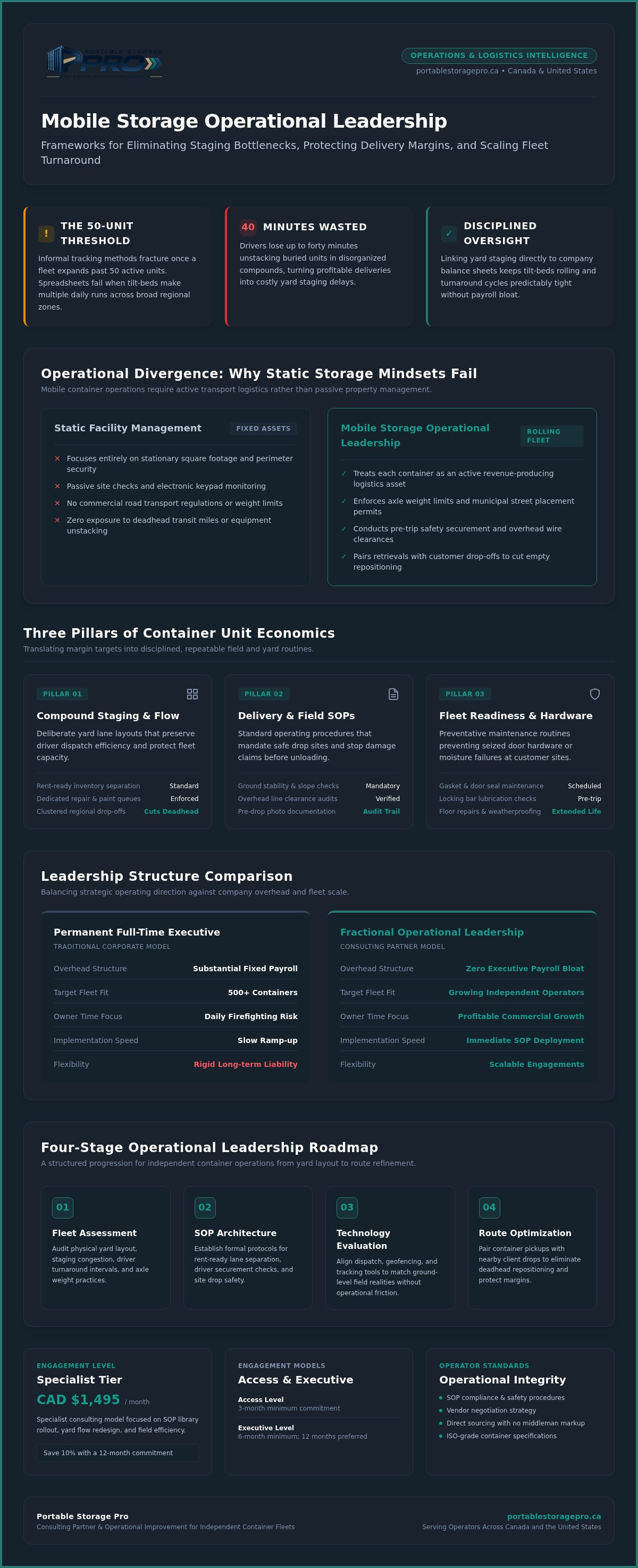
Disciplined mobile storage operational leadership focuses on the active lifecycle of rolling container assets rather than static square footage. When an independent fleet expands beyond fifty active containers, informal tracking methods inevitably fracture. What worked for a handful of boxes parked behind a small compound creates immediate bottlenecks once drivers make multiple daily runs across broad regional territories. Without structured oversight, ground-level friction compounds quickly: a tilt-bed operator spends forty minutes unstacking a buried unit, or an uninspected container arrives on a customer site with seized door hardware. Practical operational leadership bridges this gap by linking yard staging directly to company balance sheets, ensuring fleet turnaround cycles and road hours protect operating margins.
Core Responsibilities Across Yard Flow and Dispatch Logistics
Directing a container fleet requires tight alignment between yard staging and field operations. Operational leaders establish structured traffic lanes that separate rent-ready inventory from containers queued for paint touch-ups, floor repair, or gasket replacement. On the road, leadership applies proven fleet management practices to coordinate delivery routes, match driver capacity to daily bookings, and maintain continuous visibility over asset status. By pairing container retrievals with nearby customer drops, leadership minimizes deadhead mileage, lowers vehicle maintenance wear, and keeps drivers moving productively throughout their shift.
Why Traditional Self-Storage Management Fails in Portable Operations
Traditional self-storage operators manage fixed commercial real estate: perimeter security, tenant leases, and gate keypads. That stationary mindset collapses when applied to container logistics. Mobile storage demands strict compliance with commercial transport regulations, axle weight limits, and municipal street placement permits. Dynamic asset deployment requires active route planning, disciplined load securement, and consistent preventative maintenance rather than passive hallway checks.
Through focused mobile storage operational leadership, operators treat each container as a rolling revenue asset instead of a static locker. Standardizing pre-trip safety checks and site delivery criteria ensures your drivers deliver containers safely without causing site property damage or expensive repositioning delays.
Core Operational Pillars That Drive Container Unit Economics
Container unit economics succeed or fail based on daily field execution. Sustained fleet profitability depends on controlling equipment turn times, extending asset lifecycles, and eliminating unbilled transport delays. Effective mobile storage operational leadership translates high-level margin goals into disciplined, repeatable yard routines that directly improve revenue per available unit.
Yard Flow, Empty Repositioning, and Fleet Occupancy
A disorganized yard compound drains labour hours and slows vehicle dispatch. Operational leadership requires deliberate staging lane designs that keep rent-ready inventory accessible, ensuring tilt-bed drivers never wait on a forklift operator to dig out a box during peak morning departures. Proper lane layouts reduce secondary handling, equipment wear, and fuel burn. Leadership also tracks regional deployment patterns to cluster customer drop-offs with scheduled recoveries, sharply curtailing deadhead repositioning runs that consume transport capacity without generating income.
Standard Operating Procedures for Delivery and Driver Safety
Rigorous standard operating procedures (SOPs) protect your drivers, equipment, and client accounts. Clear delivery protocols mandate structured site drop inspections before unloading, confirming overhead line clearance, level grade, and ground stability to prevent soft-ground sinkage. Requiring drivers to record pre-trip securement and photograph container condition upon drop-off creates an audit trail that eliminates contentious post-rental damage disputes. Paired with scheduled preventative maintenance for door seals and locking bars, these routines keep units earning on rent rather than sitting idle in repair queues.
Technology Stack Integration for Dispatch and Asset Tracking
Technology should support physical field workflows rather than add administrative drag. Efficient operations link customer bookings directly to dispatch boards, driver routing apps, and automated billing schedules. Deploying cellular asset tracking provides total compound and field visibility, alerting dispatchers to unauthorized movements or excessive detention on client sites. Review the Modern Storage Business Tech Stack to benchmark your current systems. When updating these platforms, partnering with Portable Storage Pro helps streamline software adoption without disrupting daily delivery schedules.
Full-Time Executive vs Fractional Operational Leadership Models
When daily logistics overwhelm an independent business, owners often assume that hiring a full-time operations director is the only viable solution. That assumption often introduces severe financial strain before fleet revenue can reliably absorb it. Choosing the right mobile storage operational leadership model requires evaluating your capital constraints, fleet size, and long-term strategic control.
Overhead Burden and Limits of Permanent Internal Hires
Recruiting a permanent executive carries substantial financial weight that extends well beyond base compensation. Independent operators must account for headhunter retainers, benefits packages, performance bonuses, and mandatory payroll taxes. Once hired, an executive represents an immovable fixed cost that remains on your balance sheet regardless of seasonal rental fluctuations.
Finding qualified leadership locally is equally challenging. Regional talent pools rarely contain individuals with direct portable storage experience. Hiring a generalist from traditional warehousing or retail distribution usually backfires. These candidates often struggle with the physical realities of tilt-bed clearances, container securement rules, and heavy yard equipment management. The learning curve is expensive, and you end up paying an executive salary while they learn basic industry mechanics on your dime.
The Fractional Model: Senior Guidance Without Internal Payroll Bloat
Fractional operational leadership delivers experienced executive direction tailored to independent container companies. Instead of absorbing permanent management overhead, you engage seasoned specialists for defined strategic windows. This approach brings immediate access to tested operating frameworks, direct supplier relationships, and driver safety standards without executive recruitment delays.
This structure gives you high-level guidance while keeping company equity and operational authority firmly in your hands. Senior advisers help you standardize yard routines, refine your fleet technology, and train dispatchers, leaving you with sustainable processes rather than an inflated payroll. Review the 2026 Outsourced Storage Management Comparison Guide for a detailed breakdown of how external operational models compare to standard salaried hires.
Implementing Operational Leadership: A Four-Stage Execution Roadmap
Transitioning from owner-dependent scrambling to predictable logistics requires an orderly progression. Introducing software or expanding a fleet before fixing foundational processes only accelerates operational failure. Grounded mobile storage operational leadership introduces accountability through a structured sequence, stabilizing yard operations before scaling delivery volume.
Stage 1: Conducting Yard Workflow and Fleet Condition Audits
Real operational change begins on the ground. Inspect physical container inventory to document frame integrity, floor condition, exterior paint, and door gaskets. Categorize units into clear staging tiers: ready for delivery, awaiting minor repairs, or red-tagged for major refurbishment. Next, map compound traffic patterns to eliminate staging dead-ends and unnecessary forklift moves. Finally, review historical driver logs to identify actual turnaround times and delivery bottlenecks across your operating territory.
Stage 2: Standardizing Procedures and Enforcing Safety Compliance
Once baseline conditions are documented, codify daily routines into clear, written SOPs for container placement, recovery, and tilt-bed operations. Consult the Portable Storage Business Compliance Checklist to confirm transport safety, axle weight limits, and municipal permit protocols align with regional standards. Conduct hands-on driver sessions to enforce load securement and photographic drop documentation, removing guesswork from field safety.
Stage 3: Tracking Operational KPIs and Continuous Improvement
With baseline procedures active, focus on tracking core performance metrics. Monitor revenue per container, average turnaround days between rentals, and repair expenses per unit. Implement short, fifteen-minute weekly reviews with dispatch and yard staff to address road delays and repair backlogs. Apply proven methods for reducing storage operational costs to protect asset margins as your run volume expands.
Stage 4: Establishing Leadership Cadence and Founder Freedom
The final phase embeds regular operational reviews that separate business owners from daily dispatch friction. By delegating weekly dispatch scheduling, yard staging audits, and vendor reviews to structured operational management, owners regain the bandwidth needed to focus on market expansion. To accelerate this transition and establish lasting field discipline, partner with Portable Storage Pro to implement your operational roadmap.
Partnering with Portable Storage Pro for Operational Leadership
Building an independent container rental company gives you complete operational control, yet scaling past fifty units often traps owners in daily yard emergencies. National franchise systems promise operational blueprints, but they demand steep ongoing royalties, restrict territory growth, and dictate equipment purchasing. Portable Storage Pro offers a pragmatic alternative. We provide independent operators across Canada and the United States with dedicated mobile storage operational leadership, instilling institutional-grade yard routines and dispatch efficiency while keeping company equity entirely in your hands.
Consulting Partner vs Operating Partner: Choosing Your Model
Independent operations require different management structures depending on fleet size, capital reserves, and internal staffing. To match these operational realities, Portable Storage Pro provides two distinct leadership pathways:
- Consulting Partner: This engagement fits owners who want to maintain daily operational control while accessing executive strategy. You receive guidance on standard operating procedures, fleet assessments, and software selection, while your staff handles routine dispatch and yard tasks.
- Operating Partner: For businesses where delivery volume overwhelms ownership, this model deploys experienced specialists to direct defined operational functions directly. We manage dispatch cadences, yard staging discipline, and maintenance tracking, removing the operational burden from the founder.
Direct Sourcing and Practical Field Support
Operational strength depends on maintaining healthy container unit economics from the day equipment is acquired. Through Portable Storage Pro, operators connect directly with global container manufacturers and tracking suppliers. Under this model, supplier pricing carries zero middleman markups from our team, ensuring your capital purchases translate into immediate equity on your balance sheet.
Our work focuses strictly on practical yard realities rather than abstract corporate advice. By pairing direct procurement support with field-tested safety SOPs, dispatch optimization, and driver onboarding, we help your business build repeatable, profitable routines. Structured mobile storage operational leadership lets you secure reliable field performance, protect container margins, and focus on expanding your regional market share.
Strengthen Your Yard Operations and Fleet Margins
Scaling a container rental fleet shouldn't trap you in endless dispatch firefighting or burden your business with executive payroll bloat. Establishing disciplined mobile storage operational leadership gives your team the standard operating procedures, lane staging designs, and tracking systems needed to protect unit margins. By focusing on yard execution and transport routes first, independent operators can stabilize daily dispatch, eliminate deadhead miles, and regain valuable leadership time.
Portable Storage Pro provides pragmatic, operator-to-operator leadership tailored specifically for independent container businesses with 50 or fewer employees across Canada and the United States. Under our consulting sourcing model, you access direct supplier relationships with no middleman markup, ensuring your capital investments directly build equity. If you're ready to establish predictable yard workflows, tighten your delivery routes, and build lasting operational discipline, Let’s Talk About Your Business.
Frequently Asked Questions
What is mobile storage operational leadership?
Mobile storage operational leadership is the disciplined management of transport logistics, yard staging, driver safety, and rolling container assets. Unlike passive storage models, it focuses on the active movement of inventory across regional delivery territories. This leadership aligns daily dispatch schedules and maintenance cadences directly with company financial targets, ensuring that every container generates healthy rental margins while minimizing unpaid transit miles and staging bottlenecks.
How does operational leadership differ between portable storage and static self-storage?
Portable storage operations centre on active transport logistics, whereas static self-storage focuses on fixed property management. A portable storage leader must manage commercial truck routes, tilt-bed loading protocols, municipal placement permits, and securement standards. Static facility operators handle hallway maintenance and gate access codes. Managing portable containers requires continuous tracking of off-site physical assets and rapid equipment turnaround in an industrial yard rather than leasing stationary real estate units.
When should an independent storage operator consider fractional operational leadership?
An independent operator should consider fractional operational leadership when fleet size surpasses fifty containers and daily delivery firefighting begins pulling ownership away from commercial growth. If dispatch errors, driver delays, or unorganized yard lanes are eroding rental profitability, fractional leadership provides seasoned executive direction. It gives you the operational structure and standard operating procedures of a large enterprise without committing capital to a full-time, salaried executive payroll burden.
Can fractional leadership help improve container turnaround times and yard flow?
Yes, experienced leadership directly targets compound bottlenecks by redesigning yard traffic lanes and separating ready-to-rent units from repair inventory. By introducing structured inspection checklists and standardized prep routines, staff can turn returned boxes around in hours instead of days. Clear dispatch staging eliminates morning congestion for tilt-bed drivers, allowing your transport fleet to complete more customer drops per shift without adding extra road equipment.
How do standard operating procedures impact the resale and rental value of storage containers?
Standard operating procedures protect container value by enforcing mandatory preventative maintenance and systematic handling protocols. Documented pre-trip inspections, structured wash cycles, and immediate rust remediation keep container floors, door gaskets, and locking bars in prime condition. Preserving structural integrity and aesthetic condition prevents accelerated asset depreciation. This discipline commands premium rental rates on commercial jobsites and secures higher resale values when units eventually transition out of the fleet.
What is the difference between the Consulting Partner and Operating Partner models at Portable Storage Pro?
Portable Storage Pro provides two distinct engagements based on how much day-to-day oversight an owner wants. The Consulting Partner model offers strategic advisory, process design, and operational coaching while your internal team continues running daily business routines. In contrast, the Operating Partner model takes direct operational responsibility for defined functional areas like dispatch coordination, driver safety compliance, and maintenance scheduling, giving founders full operational relief.
Does working with an operational partner require giving up control of our storage business?
No, working with an external operational partner strengthens ownership control rather than diminishing it. You retain one hundred percent equity, ultimate commercial authority, and final approval on all capital expenditures. The partnership simply introduces field-tested systems, transparent performance reporting, and professionalized dispatch routines. Instead of reacting to daily yard emergencies, you gain clear operational visibility, allowing you to guide company growth with confidence and predictability.

Article by
Paul Taylor
Paul Taylor is the founder of Portable Storage Pro, bringing more than 35 years of experience across the container, portable storage and transportation industries. His background spans executive operations, business development, global procurement, sales, marketing and operational improvement in Canada, the UK and international markets.
Paul helps independent portable storage and container rental operators increase revenue, strengthen margins and build more efficient businesses. His work connects strategy with practical implementation, including pricing, delivery operations, supplier sourcing, staff training, technology and customer experience.
His experience includes leading multi-location storage operations and serving on the National Portable Storage Association’s board along with chairing its Canadian committee. Through Portable Storage Pro, Paul shares practical insights to help owners make informed decisions, solve operational challenges and grow profitably.
Disclaimer
Content published by Portable Storage Pro Inc. (PSP) provides general business information and industry insights. It does not replace advice tailored to your business or specialist legal, tax, engineering or other regulated advice. Reading this content or contacting PSP does not, by itself, establish a consulting engagement.
Information reflects circumstances at publication and may change. Examples and potential benefits are illustrative; results depend on individual circumstances, implementation and market conditions and are not guaranteed.
Client services are governed by the signed service agreement, agreed work plan and written amendments. Website and blog content do not amend those terms. PSP’s work is subject to applicable law and the professional commitments set out in its agreement, including the CMC-Canada Code of Professional Conduct and NPSA Code of Conduct and Ethics. Copies are available on request.
Views expressed are PSP’s own. Association membership or references do not imply association endorsement or CMC certification. Nothing in this disclaimer limits PSP’s contractual responsibilities, professional duties or rights that cannot lawfully be excluded.


