
Surrendering ten percent of your top-line revenue to a national brand won't guarantee local market dominance. When evaluating the 1-800-Pack-Rat franchise model vs independent storage operator path, establishing an agile independent business delivers superior long-term margins. You likely want proven operational systems, steady container sourcing, and market credibility, but restrictive territory boundaries and perpetual royalty fees directly erode your bottom line. You shouldn't have to surrender equity or geographic flexibility just to run a professional, scalable storage operation.
The good news is that you don't need a franchisor to achieve enterprise-grade performance. This strategic comparison evaluates the trade-offs between franchise royalties and independent agility to determine the most profitable path for your portable storage business. We break down the real operational friction points around equipment procurement, fleet control, and logistics infrastructure, showing you how to maximize revenue per container on your own terms.
Key Takeaways
- Evaluating the 1-800-Pack-Rat franchise model vs independent storage operator framework reveals that ongoing top-line royalty deductions permanently suppress operating margins compared to an independent fleet.
- Territorial geofencing restricts franchise delivery zones, while independent operators retain the freedom to capture regional commercial contracts across municipal corridors without penalty fees.
- Sourcing standard ISO-grade containers through direct supplier relationships avoids proprietary equipment surcharges and protects your unit margins.
- Adopting a purpose-built technology stack and disciplined lead intake processes allows independent yards to match the conversion speeds of national call centres.
- Engaging Portable Storage Pro through a Consulting Partner model delivers executive-level operational leadership and structured standard operating procedures without surrendering equity.
Evaluating the 1-800-Pack-Rat Franchise Model vs. Independent Growth
The mobile storage sector is expanding rapidly. Industry data projects the global market will reach $13.1 billion by 2033, with North America driving 38% of total activity. As demand rises across residential moving and job-site storage, regional business owners face a strategic crossroad: expand under a recognized corporate banner or scale an agile, self-directed business. When comparing the 1-800-Pack-Rat franchise model vs independent storage operator path, the fundamental decision balances centralized systems against bottom-line control.
National networks offer structured predictability. Operators joining the commercial franchising model gain established branding, turn-key lead routing, and strict operating playbooks designed to bypass the trial-and-error phase of launching a yard. However, that security comes at a continuous financial cost. Ongoing deductions strip substantial capital from top-line revenues before local fuel, yard leases, or payroll are settled, forcing owners to weigh corporate convenience against long-term equity.
The Structure of a National Portable Storage Franchise
National franchise systems maintain uniformity through rigid operating constraints. Licensees must adhere to standardized container designs and proprietary delivery equipment, such as specialized level-lift trailer mechanisms. While this infrastructure guarantees brand consistency and integrates with a centralized national call centre, it limits operational flexibility. Mandatory standard operating procedures (SOPs) govern every yard activity, restricting an operator's ability to modify equipment specs or customize service workflows for local clients.
The Independent Operator Perspective
Independent operators maintain complete operational agility. Instead of deferring to corporate guidelines, an independent business owner can tailor customer acquisition directly to community contractors, adjust rental rates instantly to reflect local occupancy shifts, and deploy versatile equipment. Choosing the 1-800-Pack-Rat franchise model vs independent storage operator route comes down to operational autonomy:
- Asset Flexibility: Freedom to deploy standard ISO-grade shipping containers or regional tilt-bed systems without proprietary vendor restrictions.
- Dynamic Pricing: Authority to structure competitive volume discounts for commercial builders without corporate approval delays.
- Local Market Retention: Direct control over marketing spend, focusing customer acquisition cost strictly on profitable regional commercial accounts rather than broad national campaigns.
Financial Comparison: Royalty Fees vs. Professionalized Independent Margins
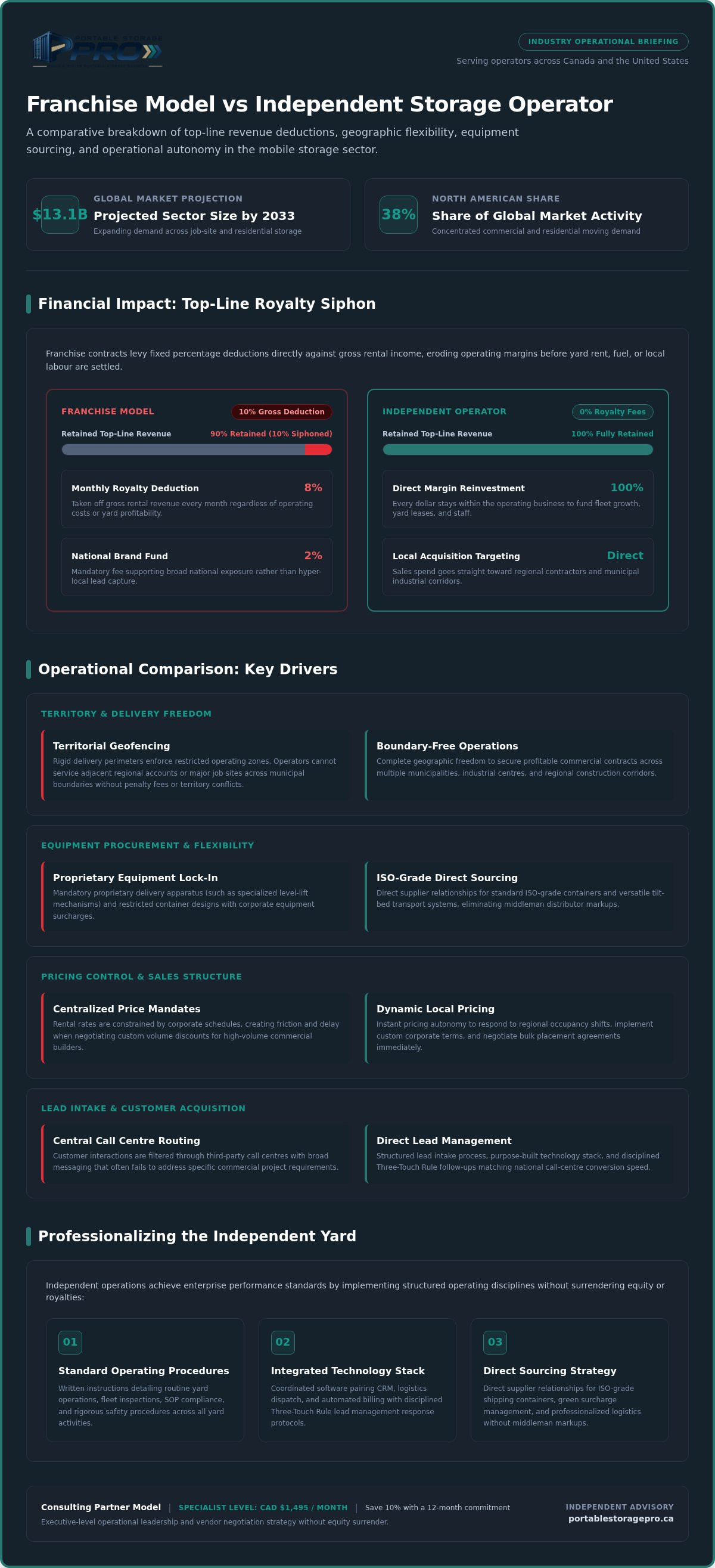
Every commercial expansion requires evaluating where cash flow goes. In the portable storage sector, the financial divergence between franchise participation and independent ownership is stark. Franchise agreements typically demand an 8% monthly royalty on gross rental revenue alongside a mandatory 2% national brand fund deduction. Siphoning 10% directly off your top line before paying for yard space, truck maintenance, or local labour drastically suppresses net operating income. Assessing the 1-800-Pack-Rat franchise model vs independent storage operator economics requires examining whether corporate brand recognition justifies this ongoing deduction.
Before entering binding agreements, reviewing the FTC's consumer guide to buying a franchise provides valuable perspective on how mandatory fees and restrictive covenants govern day-to-day operations. When marketing fees fund national awareness rather than hyper-local lead capture, your effective customer acquisition cost climbs while margin retention drops.
The Hidden Costs of Franchise Agreements
Franchise overhead extends well beyond initial licensing charges. The ongoing structural fees fundamentally elevate your fleet's break-even utilization rate:
- Gross Revenue Deductions: Top-line royalties penalize growth; as your rental asset base expands, the total dollar deduction scales perpetually.
- Mandatory System Assessments: Compulsory software licensing and national marketing contributions must be paid regardless of whether those campaigns produce qualified local bookings.
- Proprietary Surcharges: Sourcing locked-in components or branded boxes through franchisor-approved supply channels frequently incurs hidden corporate markups.
The Sourcing Advantage for Independents
Independent fleet growth bypasses these corporate layers entirely. Working through professional advisory frameworks allows operators to establish direct supplier relationships with container manufacturers and certified logistics providers. Under this model, Portable Storage Pro assists operators without adding supplier markups on sourced equipment, securing ISO-grade containers and generic hardware at true wholesale value.
A rigorous total cost of ownership analysis proves that eliminating intermediary fees accelerates asset payback. Independent procurement allows operators to retain all rental yields per box rather than remitting a permanent share to an external franchisor. Over a standard asset lifecycle, this structural margin gap provides the capital needed to expand fleet capacity, upgrade yard facilities, and build an enduring local enterprise. If you want to evaluate your procurement strategy and eliminate intermediary expenses, connecting with Portable Storage Pro offers an objective baseline for your equipment economics.
Sourcing standard units directly preserves top-line rental yields, maximizing long-term revenue per unit across your entire fleet.
Operational Control and Territorial Flexibility
Territorial sovereignty dictates how quickly a portable storage company can expand. Under a franchise structure, your operational map is tightly circumscribed by corporate geofencing. Franchise boundaries are typically drawn along specific postal codes or county lines. If a major commercial construction client, restoration company, or municipal contractor secures a project three miles past your assigned border, you cannot service them. You must surrender that revenue to a neighbouring licensee or decline the business entirely, creating artificial barriers to regional scale.
Federal standards detailed in FTC Franchise Rule compliance disclosures mandate explicit definitions of territorial rights, yet these covenants protect the franchisor's network distribution far more than your local commercial flexibility. Evaluating the 1-800-Pack-Rat franchise model vs independent storage operator dynamic highlights this operational divide: independent operators can chase high-margin commercial accounts across municipal corridors without paying inter-territory cross-dock fees or facing geographic penalties.
Geofencing and Market Limitations
Franchise boundaries produce friction in expanding metropolitan markets. In growing regions surrounding transit corridors like Toronto or Vancouver, suburban sprawl blurs defined territory edges. Franchisees face two structural disadvantages:
- Loss of Client Portability: When long-term commercial accounts move equipment between regional job sites, corporate borders force the operator to hand over accounts to another yard.
- Corporate Network Overlap: In dense corridors, sister brands or corporate-owned hubs often compete for regional accounts, diluting local customer relationships.
- Inflexible Yard Planning: Franchisors mandate strict yard layout templates, restricting an operator's ability to adjust container stacking density or delivery lanes to suit local industrial zoning codes.
Standard Operating Procedures: Mandatory vs. Custom
Scalable storage companies rely on repeatable operational routines, but operational rigor does not require rigid corporate control. Rather than obeying off-the-shelf franchise manuals that treat small yards identically to massive distribution hubs, independent businesses can implement a custom SOP library matched directly to their local team size.
Tailored standard operating procedures clarify transport workflows, site inspections, and driver safety checks while aligning directly with regional transport laws, such as Canadian National Safety Code requirements or US Department of Transportation standards. Operators with fewer than fifty staff achieve professionalized logistics through multi-role driver cross-training, systematic yard traffic paths, and disciplined staging. In the 1-800-Pack-Rat franchise model vs independent storage operator assessment, operational independence ensures that your operating procedures support your local balance sheet rather than enforcing national network conformity.
Professionalizing Your Business Without the Franchise
National brand dominance once rested on proprietary logistics software and centralized call centres. That gap has closed. Independent container operations now deploy specialized commercial tools that match or exceed national networks without paying ongoing royalty percentages. When weighing the 1-800-Pack-Rat franchise model vs independent storage operator strategy, modern operators can assemble a purpose-built storage business tech stack using off-the-shelf logistics platforms, automated dispatch software, and integrated customer relationship management tools.
Operating independently no longer means working with fragmented spreadsheets or uncoordinated phones. By implementing disciplined systems, you gain institutional credibility, capture higher regional market share, and maintain complete operational control.
Lead Conversion and Sales Strategy
National call centres offer speed, but they lack regional expertise. A locally managed sales pipeline converts commercial contractors faster because your staff understands municipal delivery permits, local job sites, and access restrictions. Independents can improve storage lead conversion by enforcing strict sales disciplines:
- The Three-Touch Rule: Establish a rigid follow-up cadence that triggers an immediate quotation response, a secondary phone check-in within 24 hours, and a final structured follow-up on day four.
- Automated Lead Intake Process: Capture online quote submissions directly into an automated pipeline to ensure customer inquiries receive real-time SMS and email confirmations.
- Local Search Positioning: Focus marketing capital on regional B2B search terms and direct commercial outreach instead of contributing to broad national advertising funds.
Procurement and Supply Chain Resilience
Direct fleet expansion demands structured supply chain management. Rather than relying on a franchisor to allocate inventory at marked-up internal rates, independent operators can manage port logistics directly. Coordinating drayage, customs clearance, and yard delivery for ISO-grade shipping containers secures reliable assets while protecting your balance sheet.
Establishing a forward-looking procurement calendar ensures orders are placed well ahead of seasonal utilization spikes, avoiding elevated spot freight rates. Rigorous vendor reliability assessments safeguard fleet expansion by verifying that suppliers consistently hit production tolerances, paint durability standards, and committed delivery windows. When you want to upgrade your dispatch systems, implement disciplined operational workflows, and scale your fleet efficiently, partner with Portable Storage Pro to establish an enterprise-grade operating model.
Navigating the 1-800-Pack-Rat franchise model vs independent storage operator decision ultimately proves that enterprise-grade operational systems can be deployed independently, allowing you to build lasting enterprise value under your own banner.
Strategic Growth: How Portable Storage Pro Supports Independents
Building an enterprise-grade container fleet does not require surrendering equity or locking your cash flow into perpetual royalty contracts. The central question behind the 1-800-Pack-Rat franchise model vs independent storage operator evaluation is how to secure institutional systems without the franchise overhead. Portable Storage Pro provides the operational infrastructure, standard operating procedures, and vendor negotiation strategies that independent operators need to scale profitably while retaining 100% equity.
Advisory and Implementation Support
Small to mid-sized yards rarely require full-time internal executives to resolve logistical bottlenecks. Through fractional operational leadership, operators gain senior industry guidance tailored to their fleet size without taking on executive salary overhead. Portable Storage Pro maintains a clear separation between its primary partnership tiers:
- Consulting Partner: Business owners maintain full operational responsibility for daily yard management while receiving strategic roadmaps, tech stack assessments, and direct sourcing workflows without supplier markups.
- Operating Partner: A collaborative arrangement where Portable Storage Pro takes direct oversight of operational systems, workflow execution, and yard performance.
Through dedicated options such as the Growth engagement model, yards scaling toward multi-market footprints translate strategic goals into concrete operating procedures. These focus on driver staging efficiency, container turn-times, and maximizing revenue per container across commercial accounts.
Building a Better Portable Storage Business
When assessing long-term enterprise value, independent ownership commands significant advantages in mergers and acquisitions. Strategic buyers actively seek clean operating balance sheets unencumbered by franchisor transfer approvals, restrictive territory caps, or perpetual brand fund deductions. Building an independent brand supported by documented SOPs and strong commercial retention yields superior transferable value whether you plan an eventual sale or a generational family transition.
Deciding between the 1-800-Pack-Rat franchise model vs independent storage operator route ultimately depends on whether you want to finance someone else's national network or compound your own enterprise equity. If you are ready to optimize your logistics, secure direct supplier relationships, and scale your independent yard profitably, Let’s Talk About Your Business.
Taking Command of Your Fleet and Operating Margins
Resolving the 1-800-Pack-Rat franchise model vs independent storage operator debate comes down to long-term profitability and asset control. Surrendering ten percent of your gross revenue for brand name recognition permanently limits your compounding capital. Operating independently allows you to service commercial clients across any boundary, adapt your fleet to local market demand, and retain full equity in your business.
You don't need a franchisor to achieve institutional operational discipline. By working with Portable Storage Pro, independent operators gain direct access to container supply chains with zero middleman markups on sourced equipment. You receive custom SOP development tailored to your team size and access to senior industry leadership without hiring full-time executives. If you are ready to expand your footprint while protecting your unit margins, Explore how a Consulting Partner can professionalize your operation and build an enduring, profitable company on your own terms.
Frequently Asked Questions
What are the typical royalty fees for a portable storage franchise in 2026?
Most mobile storage franchise systems charge an ongoing royalty between 8% and 10% of gross rental revenue. This deduction typically combines a recurring operational royalty with a mandatory brand marketing contribution. Some networks structure fees on a fixed monthly basis per container. Regardless of structure, these fees are deducted directly from top-line revenue before factoring in local fuel, yard leases, or payroll expenses.
Can an independent operator get the same container pricing as a national franchise?
Yes, independent yards can secure competitive wholesale manufacturing rates through direct supplier relationships. Working with an advisory resource like Portable Storage Pro gives operators direct factory access to ISO-grade containers without middleman markup under a consulting sourcing model. By managing port logistics and forward planning on a seasonal procurement calendar, independents match or exceed franchise purchasing efficiencies while avoiding proprietary equipment markups.
How does a lead management system for independents compare to a franchise call centre?
Franchise call centres offer high answering speeds, but they lack local knowledge of regional roads, permit rules, and commercial job sites. Modern independent lead intake software centralizes inbound inquiries instantly via automated email and SMS confirmations. By combining quick automated responses with direct local staff follow-up, independent operators frequently convert high-value commercial accounts faster than a distant call centre agent working off a rigid script.
Is it harder to sell an independent storage business than a franchise location?
No, independent portable storage businesses often command cleaner valuations in mergers and acquisitions. Strategic buyers prefer purchasing companies with unencumbered balance sheets that lack ongoing royalty obligations or restrictive territorial boundaries. When examining the 1-800-Pack-Rat franchise model vs independent storage operator comparison, independent businesses with documented standard operating procedures and strong B2B commercial accounts offer greater transferable enterprise value and exit flexibility.
What is the "Three-Touch Rule" in portable storage sales?
The Three-Touch Rule is a disciplined sales follow-up procedure designed to increase container rental conversion rates. It requires an immediate quote response upon inquiry, a structured phone or email check-in within 24 hours, and a final follow-up contact on day four. This structured cadence ensures your sales pipeline actively nurtures potential commercial and residential customers before competitors can respond.
What are the benefits of fractional operational leadership for storage owners?
Fractional operational leadership gives independent owners access to seasoned C-suite guidance without the cost of a full-time executive salary. Through an advisory arrangement like Portable Storage Pro's Consulting Partner model, business owners obtain expert guidance on fleet logistics, standard operating procedures, vendor negotiations, and technology stack optimization. This targeted support resolves operational bottlenecks while allowing owners to retain complete corporate control and equity.
Do I need a specific tech stack to compete with 1-800-Pack-Rat?
You don't need proprietary systems to compete effectively. In evaluating the 1-800-Pack-Rat franchise model vs independent storage operator landscape, off-the-shelf software platforms provide enterprise-grade capabilities. A competitive independent technology stack combines specialized container rental billing software, real-time driver dispatch applications, telematics tracking hardware, and an automated customer relationship management tool. These tools deliver seamless tracking and customer communication without franchise licensing fees.
How do territorial restrictions work in portable storage franchise agreements?
Franchise contracts designate strict geographic boundaries based on postal codes or municipal borders. Licensees cannot solicit or drop containers outside their defined zone, even for long-standing commercial accounts moving between construction projects. Independents operate without geofencing rules. You can follow contractors across regional borders, service profitable municipal accounts, and optimize route density wherever customer demand dictates, keeping every dollar of earned revenue.

Article by
Paul Taylor
Paul Taylor is the founder of Portable Storage Pro, bringing more than 35 years of experience across the container, portable storage and transportation industries. His background spans executive operations, business development, global procurement, sales, marketing and operational improvement in Canada, the UK and international markets.
Paul helps independent portable storage and container rental operators increase revenue, strengthen margins and build more efficient businesses. His work connects strategy with practical implementation, including pricing, delivery operations, supplier sourcing, staff training, technology and customer experience.
His experience includes leading multi-location storage operations and serving on the National Portable Storage Association’s board along with chairing its Canadian committee. Through Portable Storage Pro, Paul shares practical insights to help owners make informed decisions, solve operational challenges and grow profitably.
Disclaimer
Content published by Portable Storage Pro Inc. (PSP) provides general business information and industry insights. It does not replace advice tailored to your business or specialist legal, tax, engineering or other regulated advice. Reading this content or contacting PSP does not, by itself, establish a consulting engagement.
Information reflects circumstances at publication and may change. Examples and potential benefits are illustrative; results depend on individual circumstances, implementation and market conditions and are not guaranteed.
Client services are governed by the signed service agreement, agreed work plan and written amendments. Website and blog content do not amend those terms. PSP’s work is subject to applicable law and the professional commitments set out in its agreement, including the CMC-Canada Code of Professional Conduct and NPSA Code of Conduct and Ethics. Copies are available on request.
Views expressed are PSP’s own. Association membership or references do not imply association endorsement or CMC certification. Nothing in this disclaimer limits PSP’s contractual responsibilities, professional duties or rights that cannot lawfully be excluded.


