
What if the process slowing your portable storage operation isn’t the one that looks busiest? A delay in quote follow-up can affect bookings, while a missed handoff between dispatch and the yard can leave a container unready when a customer needs it. Storage business process optimization starts by tracing these connections, not changing routines by guesswork.
You may already see the symptoms: leads, deliveries, yard activity, fleet readiness and billing depend on separate routines. The challenge is identifying which constraint has the greatest practical effect, then checking whether addressing it could improve customer service or asset use. That calls for clear measures and a process the team can maintain.
This guide offers a repeatable way to map key workflows, locate bottlenecks and choose measures tied to business outcomes. You’ll see how to assess handoffs across quote follow-up, delivery and pickup cycles, container preparation and billing, then test a focused change against a clear baseline. The goal is not to add layers of administration. It’s to make the work easier to track, improve and repeat as your operation grows.
Key Takeaways
- Start storage business process optimization by tracing the customer journey from inquiry through delivery, use and return.
- Compare documented procedures with work as it actually happens to uncover missed handoffs and check the causes of bottlenecks.
- Choose measures for lead response, quote conversion, delivery reliability, empty repositioning, fleet utilisation and rework.
- Set an intended outcome, assign a process owner and involve the team members who perform or receive each handoff.
- Match process changes to your team’s capacity, then use the results to decide what to refine or standardise next.
Why storage business process optimization starts with the operator workflow
Start by tracing work from the customer inquiry through delivery, use and return. Storage business process optimization means improving a repeatable workflow against a defined operating or customer outcome, such as more reliable delivery commitments or fewer booking errors. A written procedure explains how work should happen. Optimization tests whether a change to its timing, consistency, quality or results would help the workflow perform better.
Look at the full chain before changing one step. A faster booking process, for example, may send more orders to dispatch before the yard can confirm container readiness. What looks like a sales improvement can then create a scheduling problem for operations and an uncertain commitment for the customer. An introduction to business process management can help frame improvement as a connected cycle of understanding and refining work.
What does process optimization mean in a portable storage business?
Consider a rental booking: a lead arrives, a quote is prepared, the customer confirms, dispatch schedules delivery, and the yard stages a suitable container. Optimization means identifying a specific result to improve, adjusting the workflow and checking what happens. A handoff is where responsibility or information passes between people or teams. A bottleneck is a step that restricts the flow of work. A baseline records current performance for comparison. The process owner coordinates the workflow and follows up on agreed changes, while others remain responsible for their own tasks.
For example, slow quote follow-up may mean a prospect books elsewhere or remains unconfirmed while dispatch plans around uncertain demand. The effect can reach beyond sales: the team may have less dependable information for delivery scheduling and fleet allocation. First, establish how quotes are handled now and what happens after each response or delay. Then define the outcome you want to change before revising the follow-up steps.
Which operator workflows are connected?
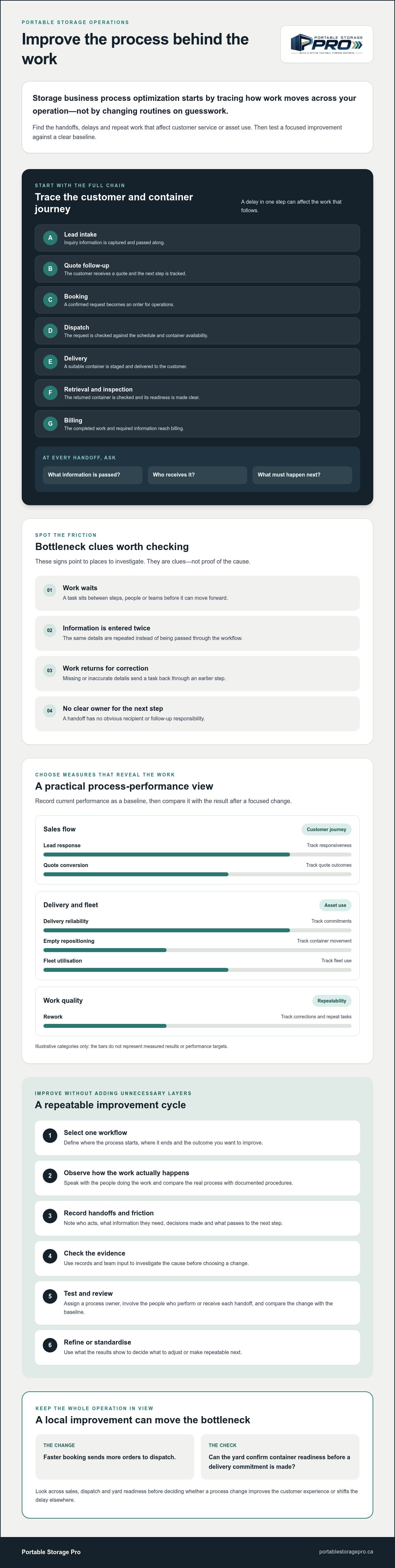
Trace the sequence across lead intake, quote follow-up, booking, dispatch, delivery, retrieval, inspection and billing. At each handoff, check what information is passed, who receives it and what must happen next. Yard flow and fleet readiness are part of this chain. If a returned container hasn’t been inspected or prepared, dispatch may need to revise a planned delivery or customer commitment.
The priority depends on your operation. A team handling inquiries through separate channels may need to examine lead intake first. An operator having difficulty confirming available containers may need to trace retrieval, inspection and yard preparation. Fit the improvement to your staffing, business size and existing systems. Start with how work is actually done instead of adding a tool or procedure before confirming the source of the problem.
How to map portable storage processes and find operational bottlenecks
Map one workflow at a time, from a defined start point to a clear finish. For example, trace a booked container delivery from dispatch receiving the order to the customer receiving the container. Observe the work and speak with the people handling each step. Then review existing records. A written procedure may not reflect how staff manage exceptions, update information or pass work between roles.
Use a repeatable sequence: select the workflow, trace its steps, record each handoff, flag friction and check the evidence before deciding what to change. Note where work waits, gets entered twice, returns for correction or has no clear owner. These are clues, not proof of the cause. Operations management principles connect process choices to the flow of work and the outcomes the business needs.
How do you document the current process?
Follow a customer or container journey and define its beginning and end. For each step, record who acts, what information they need, any decision they make and what they pass along. A simple swimlane view can make gaps between roles visible:
Sales: Receives booking details and confirms the delivery request. Output: complete order information for dispatch.
Dispatch: Checks the request against the schedule and container availability. Decision: Is a suitable unit ready for the requested delivery? Output: confirmed job details or a request for clarification.
Yard: Locates and prepares the assigned container. Input: confirmed job details. Output: container staged for loading, or an exception reported to dispatch.
Driver: Receives the delivery assignment and completes the move. Output: delivery status for the team to record and use for follow-up.
Mark missing details, duplicate entry, unclear ownership and rework directly on the map. Keep it practical: a shared document or whiteboard can show the sequence without requiring new software. If a step branches, such as when the assigned unit isn’t ready, record the decision and what happens next. This helps the team see whether an exception has a clear path or simply creates another delay.
How can you confirm the cause of a bottleneck?
Separate the symptom from the suspected cause. A late delivery is a symptom. Incomplete dispatch information, a container not ready in the yard or a scheduling conflict could be causes. Compare staff observations with available timestamps, quote or booking records, dispatch notes and service issues. Check whether the pattern recurs or appears only with a particular exception or capacity constraint.
Ask the people involved to verify the sequence before treating a theory as fact. Note what the records confirm, what remains uncertain and what additional observation could help. Once the team agrees on where and why work stalls, you have a stronger basis for testing a change.
Which storage business performance measures reveal process problems?
For storage business process optimization, choose measures that help you decide what to change, not just report activity. Establish a business-specific baseline, then compare results after a process change. The Association for Supply Chain Management describes business process redesign as part of operations management. Your measures, however, should reflect your own fleet, service commitments and records. Don’t set targets until you know what your current data can reliably show.
Use the same definition, data source, owner and review schedule for each measure. A weekly review may suit active delivery work; sales measures may need to be compared across a consistent group of inquiries or quotes. Agree on the denominator and time period first, so a change in the results reflects performance rather than a change in how the metric is counted.
| Workflow | Measure and definition | Decision it can inform |
|---|---|---|
| Lead handling | Lead response time: elapsed time from inquiry receipt to first meaningful response. | Where to adjust lead assignment, alerts or follow-up responsibilities. |
| Quoting | Quote conversion: bookings divided by quotes issued for a consistently defined group and period. | Whether to investigate quote follow-up, qualification or booking handoffs. |
| Delivery | Delivery reliability: deliveries completed within the confirmed window divided by deliveries due. | Which scheduling, dispatch or readiness issues to investigate. |
| Repositioning | Empty movement: empty kilometres or moves recorded by route, job or period. | Whether to review sequencing, retrieval planning or container placement. |
| Fleet and yard | Fleet utilisation: units on rent compared with the serviceable fleet over a defined period. | Whether to examine availability, idle time, fleet allocation or readiness. |
| Job completion | Rework: repeat actions or corrections needed to complete a delivery, retrieval or inspection. | Where clearer information, training or a process change may reduce avoidable repeat work. |
Connect measures to where the issue began
A customer complaint may surface after delivery, but the originating problem could be an unclear quote, missing booking detail or incomplete dispatch instructions. Record the issue against the step where it began as well as where it became visible. Review delivery timing, repeat trips and empty mileage only when operating records are consistent enough to support a comparison.
Use fleet data to answer an operating question
Review container availability, readiness, idle time and repositioning alongside demand patterns. GPS or asset tracking is useful when it answers a defined question, such as where units are sitting or whether a planned retrieval was completed. Check how the information will change a decision before adding another tool. For practical tracking considerations, see the portable storage asset tracking guide.
How to implement process improvements without overloading the team
Once the team has verified a bottleneck, make one focused change. Define the intended outcome first, such as fewer incomplete dispatch handoffs or more consistent container readiness. Assign a process owner to coordinate the trial and involve the people who perform and receive the work. This keeps storage business process optimization grounded in daily operations rather than adding a procedure the team can’t maintain.
Pilot the change in a manageable part of the workflow. Record exceptions, compare the result with the baseline using the same measure, and ask staff where the new steps helped or created friction. Adjust the process before adopting it more widely. A change that works under routine conditions may still need a clear path for unusual bookings, unavailable containers or schedule changes.
| What you find | Practical response | Use it when |
|---|---|---|
| Steps or ownership are unclear | Clarify the workflow and handoff responsibilities. | Work stalls because staff aren’t sure who acts next or what information to pass on. |
| Staff need consistent execution | Provide focused training and check understanding during the pilot. | The process is clear, but team members need guidance to follow it consistently. |
| A repeatable task needs written instructions | Update or create an SOP with steps, safety guidance and escalation points. | Consistency or safe completion depends on staff having a reliable reference. |
| Information is repeatedly delayed or re-entered | Assess whether a technology change can improve the specific handoff. | Tools can address a confirmed information gap and the team can support the change. |
Make SOPs useful, not burdensome
Document repeatable tasks when staff need consistent steps, safety guidance or a clear escalation route. Keep the procedure practical, assign an owner and revisit it when operating conditions change. Don’t add documentation simply to record a process that still has a confirmed problem. An SOP should make the agreed workflow easier to follow, not add steps without addressing the need.
Choose technology only when it solves a defined problem
A CRM, logistics or billing tool should support a specific decision or handoff. Before making a change, check whether the required information is accurate, whether staff can adopt the new steps, how the system will connect with existing tools and what the team should do if it’s unavailable. The modern storage business tech stack reference can help frame that review. For related performance considerations, see the portable storage profitability guide.
Portable Storage Pro provides advisory support for operators reviewing operational improvement, training or technology decisions. Consider discussing your priorities when specialist input would help the team assess its options.
How Portable Storage Pro can support storage business process optimization
Portable Storage Pro provides advisory support for independent and growing portable storage companies. If you’ve identified a recurring bottleneck, the work can begin with the operating priority and evidence you’ve gathered, then focus on an agreed next step. Depending on the need, support can address operations, training, procurement, sales, marketing, technology, delivery systems, customer experience or growth strategy.
Clarify the division of responsibility. Your team retains day-to-day management and remains responsible for business decisions and assigned implementation tasks. Advisory support can help assess a workflow, evaluate options and plan changes, but it does not automatically transfer operational management. Agreeing on responsibilities at the outset helps ensure the work fits your team’s capacity and operating realities.
What should you clarify before seeking outside support?
Bring a clear account of the problem, not just its most visible symptom. Before a discussion, outline:
- The workflow: where the process starts and ends, and which roles take part.
- The evidence: examples from operating records and observations from the people involved.
- The intended outcome: what should improve for customers or the business.
- The internal owner: who will coordinate decisions and follow-up within your team.
Then clarify what kind of help would be useful. You may need advice to diagnose a handoff, implementation support to put an agreed change into practice, training to help staff follow a revised process, or a technology review to assess whether your systems support the work. These are different needs. Identifying yours helps keep the scope practical.
What is a practical next step?
Choose one recurring point of friction, such as delayed quote follow-up, incomplete dispatch information or uncertainty about container readiness. Gather relevant examples and ask the people who perform or receive the handoff what happened, what information they needed and where the work slowed down. Bring the current process, useful records and specific questions to a business discussion.
If procurement is part of the workflow, Portable Storage Pro can provide advisory expertise in procurement and sourcing. Start with a defined need, such as identifying the steps and information required to assess an equipment sourcing decision.
For a focused discussion about your workflow or operating priority, talk with Portable Storage Pro about your business.
Make your next process improvement practical
Effective storage business process optimization starts with work as it happens. Trace a connected workflow, verify where delays or rework begin, and choose a measure that reflects the customer or operating outcome you want to improve. Then test one focused change, involve the people responsible for each handoff and refine the process before making it standard practice.
The right priority depends on your operation. It may sit in quote follow-up, dispatch, yard readiness, fleet movement or another recurring handoff. Portable Storage Pro offers advisory expertise for portable storage companies across operations, training, procurement, sales, marketing, technology, delivery systems, customer experience and growth strategy.
Bring one workflow, the evidence you have and the questions your team needs to resolve. Let’s Talk About Your Business and discuss a practical next step. A clear view of the process gives you a sound place to start, while measured improvements can help your team build workflows it can maintain as the business grows.
Frequently Asked Questions
What is storage business process optimization?
Storage business process optimization is the structured review and improvement of repeatable workflows to improve a defined operating or customer outcome. For a portable storage operator, workflows may include lead intake, quote follow-up, dispatch, delivery, retrieval, inspection and billing. Start by documenting how work happens now. Then check where delays, rework or unclear ownership affect the process, rather than assuming the written procedure reflects daily practice.
How do I identify bottlenecks in a portable storage business?
Follow a workflow from start to finish, recording each step, role, handoff and decision. Compare that map with staff observations and available records, such as quote timestamps or dispatch notes. Look for recurring waits, duplicate entry, rework and unclear ownership. A late delivery, for example, is a symptom, not proof of the cause. Confirm what is creating the delay with the people involved before changing the process or choosing a tool.
Which metrics should a portable storage operator track?
Track measures that answer a specific operating question. Depending on your workflow, these could include quote follow-up, quote conversion, delivery reliability, empty repositioning, container availability, fleet utilisation or rework. Define each measure consistently, name its data source and owner, and establish a baseline before setting a goal. For example, compare delivery performance using the same definition of an on-time delivery and the same review period.
How can I improve container utilization without adding more containers?
Review how demand, container availability, storage, delivery, retrieval and repositioning interact. Identify units sitting idle or positioned away from upcoming work, then check whether scheduling or information handoffs contribute. The right response depends on your service model and the quality of your operating records. Use a consistent fleet utilisation definition, compare performance with a baseline and assess whether changes to allocation or scheduling improve asset use without disrupting customer commitments.
Does a portable storage business need software to optimize its processes?
No. A clear process owner, consistent records or a practical SOP may address a workflow issue without new software. A CRM, logistics or billing tool may help when the defined problem involves shared information, scheduling, tracking or automation. Before comparing options, identify the decision the tool should support. Also check data quality, staff adoption, integration with existing systems and how the team will continue the work if the tool is unavailable.
When should a portable storage operator seek process improvement support?
Consider outside expertise when a recurring bottleneck crosses teams, internal capacity is limited or a planned change affects several business functions. Before starting, identify the workflow, available evidence, desired outcome and internal process owner. Clarify whether the support involves advice, implementation support, training or a technology review, and which tasks remain with your team. Portable Storage Pro provides advisory support for portable storage companies, while owners retain day-to-day operating responsibility.
Ready to discuss a workflow or operating priority in your business? Let’s Talk About Your Business.

Article by
Paul Taylor
Paul Taylor is the founder of Portable Storage Pro, bringing more than 35 years of experience across the container, portable storage and transportation industries. His background spans executive operations, business development, global procurement, sales, marketing and operational improvement in Canada, the UK and international markets.
Paul helps independent portable storage and container rental operators increase revenue, strengthen margins and build more efficient businesses. His work connects strategy with practical implementation, including pricing, delivery operations, supplier sourcing, staff training, technology and customer experience.
His experience includes leading multi-location storage operations and serving on the National Portable Storage Association’s board along with chairing its Canadian committee. Through Portable Storage Pro, Paul shares practical insights to help owners make informed decisions, solve operational challenges and grow profitably.
Disclaimer
Content published by Portable Storage Pro Inc. (PSP) provides general business information and industry insights. It does not replace advice tailored to your business or specialist legal, tax, engineering or other regulated advice. Reading this content or contacting PSP does not, by itself, establish a consulting engagement.
Information reflects circumstances at publication and may change. Examples and potential benefits are illustrative; results depend on individual circumstances, implementation and market conditions and are not guaranteed.
Client services are governed by the signed service agreement, agreed work plan and written amendments. Website and blog content do not amend those terms. PSP’s work is subject to applicable law and the professional commitments set out in its agreement, including the CMC-Canada Code of Professional Conduct and NPSA Code of Conduct and Ethics. Copies are available on request.
Views expressed are PSP’s own. Association membership or references do not imply association endorsement or CMC certification. Nothing in this disclaimer limits PSP’s contractual responsibilities, professional duties or rights that cannot lawfully be excluded.


