
The greatest threat to your portable storage growth isn't the marketing budget of a national giant; it's the operational inefficiency baked into your current procurement and delivery systems. You likely recognize that competing with national franchises feels like an uphill battle, especially when you're facing high container costs and fragmented logistics. It's frustrating to watch larger entities dominate the market simply because they have better systems, not necessarily better service.
This article outlines how to successfully replicate and surpass the PODS business model for independents by leveraging professionalized logistics, direct procurement, and modern technology. We'll provide a 2026 strategic blueprint that focuses on lowering your unit procurement costs and implementing SOPs that allow you to step back from daily operations. You'll discover how to build a scalable framework that transforms your business from a local labour of love into a high-performance asset that rivals the industry's biggest names. By removing middleman markups and professionalizing your internal processes, you can achieve the steady reliability and focused ambition required to lead your local market.
Key Takeaways
- Access global supply chains to bypass local brokers and secure direct-from-factory container pricing.
- Replicate the PODS business model for independents by integrating specialized logistics with centralized technology to streamline your fleet management.
- Evaluate the true cost of franchising to understand how independent operators can maintain 100% profit retention while avoiding territory restrictions.
- Adopt a fractional operational leadership model to professionalize your management structure and reduce owner burnout.
- Standardize your internal SOPs to centre your operations around a seamless customer experience from the initial lead through to final container pick-up.
Deconstructing the PODS Business Model: Why It Dominates
The dominance of the PODS model is not accidental. It relies on a calculated synergy between specialized logistics, durable hardware, and centralized technology. Most observers see the containers, but the real power lies in the proprietary delivery mechanism that keeps those containers level during transit. This horizontal lift system revolutionized the industry by virtually eliminating the shifting of contents, a common failure point in traditional towing or tilt-bed delivery. For those studying the PODS business model for independents, this mechanical advantage represents a significant hurdle that requires a strategic approach to overcome.
The revenue structure of this model reveals a sophisticated balance. It pairs steady, monthly recurring revenue from long-term storage with high-margin transactional fees from local and long-distance moving. This dual-stream approach ensures cash flow stability while allowing for aggressive growth during peak moving seasons. However, the barrier to entry remains high. The capital-intensive nature of specialized trucks and high-grade container fleets often forces independent operators into a defensive posture, competing on price rather than operational excellence. To compete, independents must move beyond basic equipment and adopt a more professionalized framework.
Logistics as a Competitive Moat
A primary advantage of the national model is the efficiency of a hub and spoke distribution system. By centralizing containers in a secure storage centre, operators can optimize their delivery routes and maximize fleet utilization. Specialized equipment isn't just a capital expense; it's a risk management tool. Using refined delivery systems reduces property damage claims on residential driveways, which directly correlates to higher customer trust and lower insurance premiums. Professionalism in the field creates a more resilient bottom line.
The Technology Gap for Independents
By 2026, the consumer expectation for a digital-first rental experience has become non-negotiable. National giants use centralized booking systems that offer instant quotes and real-time container tracking. Many independent operators struggle because they rely on manual dispatching and fragmented communication. This technology gap impacts fleet utilization. Without real-time data, it's difficult to know exactly where every asset is or when it will become available for the next high-value move. Closing this gap is essential for any operator looking to scale the PODS business model for independents effectively.
The Three Pillars of an Independent Storage Powerhouse
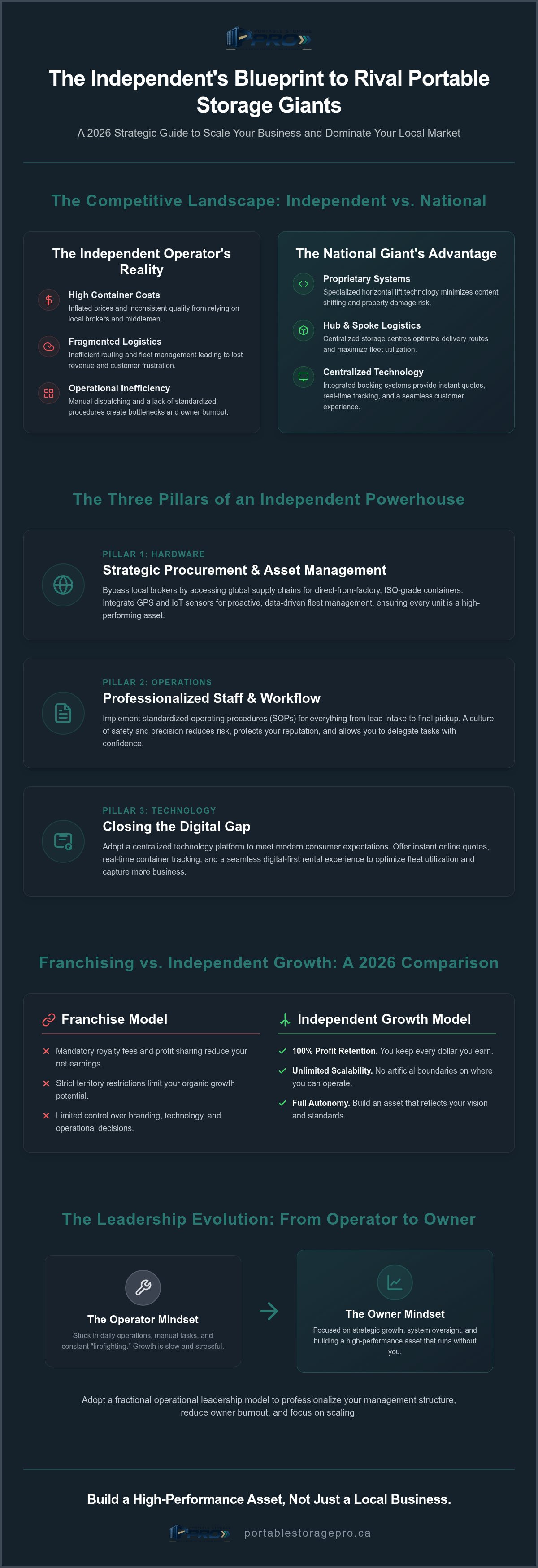
Scaling a portable storage operation requires a shift from reactive management to a systems-based approach. While the national giants rely on massive infrastructure, independent operators can achieve similar results by focusing on three specific pillars. Successfully executing the PODS business model for independents means moving beyond the small-scale mentality and building an asset that operates with precision. To do this, you must prioritize how you acquire hardware, how you manage your staff, and how you capture new business.
Hardware: Sourcing Quality and Durability
Your hardware is the physical foundation of your brand. Many operators settle for local brokers, but this often results in inconsistent quality and inflated costs. By 2026, professionalized procurement means accessing global supply chains to source ISO-grade containers directly. These units offer the structural integrity needed for long-distance moves and multi-year storage cycles. Colour consistency and professional branding across your entire fleet aren't just aesthetic choices; they are essential for long-term asset value and brand recognition. Integrating GPS and IoT sensors into every unit provides the data necessary for proactive fleet management, allowing you to monitor utilization without manual inventory checks. This level of oversight ensures your capital is always working as hard as possible.
Operations: Professionalizing the Staff and Workflow
Operational excellence is built on the back of standardized training and repeatable workflows. A culture of safety and precision in container delivery reduces the risk of property damage and protects your reputation. When every staff member follows the same SOPs, from lead intake to container pick-up, you eliminate the friction that typically slows down growth. This is a core component of scaling a portable storage business. Systems allow you to delegate tasks with confidence, ensuring that your high standards are met even during your absence. Professionalizing these internal processes is what separates a local service from a scalable powerhouse. It transforms the business into a manageable asset rather than a daily burden.
Lead generation must also evolve to match this operational maturity. Relying on local visibility or word-of-mouth is insufficient for rapid expansion. High-intent digital marketing strategies allow you to reach customers exactly when they begin their moving or renovation journey. By capturing these leads through centralized tech, you can manage conversions more effectively and predict future demand. If you're looking to refine these systems, exploring a professional procurement and sourcing strategy can help remove the middleman markups that often stifle independent growth and limit your ability to scale.
Franchising vs. Independent Growth: A 2026 Comparison
Deciding between a franchise agreement and independent growth is a pivotal moment for any operator. While franchises provide a recognizable name, they often come with restrictive covenants that limit your long-term upside. When analyzing the PODS business model for independents, it becomes clear that the hidden costs of franchising, such as ongoing royalties and mandatory marketing fees, can significantly erode your margins. These fees often support a national brand rather than your specific local market presence. Choosing the independent path allows for 100% profit retention and total control over your service area.
This autonomy is a primary driver for increasing portable storage business profitability. By avoiding the heavy overhead of a franchise, you can reinvest those funds into high-grade hardware or more aggressive local lead generation. The hybrid solution involves leveraging expert consulting to implement franchise-level systems while maintaining your status as an independent owner. This approach provides the professionalized SOPs you need without the burden of a permanent royalty leash.
Control and Customization
Independent operators possess a level of agility that national franchises simply cannot match. You can pivot your service offerings based on local economic shifts without waiting for corporate approval. You're free to select a tech stack that fits your specific workflow rather than being forced into a generic, proprietary system. Most importantly, you own the brand equity. You aren't leasing a name; you're building a legacy that belongs entirely to you. This freedom allows you to centre your business around your own vision for growth.
Profitability and Long-Term Value
From a financial perspective, a well-run independent operation often boasts a superior EBITDA margin compared to its franchised counterparts. Professionalized independents are becoming highly attractive acquisition targets for private equity and larger regional players. By implementing a clear portable storage expansion strategy, you increase the exit value of your business. Strategic buyers look for robust systems and clean financials, both of which are easier to maintain when you aren't tethered to a franchisor's rigid and often expensive reporting requirements. The PODS business model for independents is most effective when it combines this financial independence with the same level of operational discipline found in national chains.
Strategic Procurement and Operational Leadership
Strategic procurement is the critical engine that drives the PODS business model for independents. To compete at a national level, you must move beyond the limitations of local brokers who add unnecessary layers of cost to every transaction. Accessing direct-from-factory container pricing is not just a cost-saving measure; it's a fundamental shift in how you capitalize your business. By taking control of your procurement, you ensure that your margins remain healthy even as competition intensifies in the 2026 market. Professionalizing this aspect of your business allows you to secure high-grade hardware at prices that were previously only available to national franchises.
Optimizing the Global Supply Chain
Navigating the global supply chain requires a deep understanding of international port logistics and the mechanics of container sourcing. You need to manage lead times effectively, especially given the fluctuations in shipping schedules that can impact your growth trajectory. Reducing landed costs is achieved through bulk procurement and timing your orders to coincide with favourable shipping rates. It's also vital to ensure that every unit meets specific Canadian standards for portable structures, protecting your business from regulatory friction. This level of logistical precision allows you to maintain a consistent fleet of high-grade assets without the middleman markups that stifle smaller operators.
Fractional Management: The Modern Growth Lever
Operational leadership doesn't always require a full-time, high-salaried executive. Many successful independents are now utilizing fractional operational leadership to implement world-class systems. This model allows you to access seasoned expertise for staff training and sales system implementation without the permanent overhead of a full-time hire. It shifts the owner’s focus away from daily fire-fighting and toward high-value strategy. By auditing your current fleet for delivery and maintenance inefficiencies, a fractional leader identifies exactly where your revenue is leaking. Integrating a technology stack that automates up to 70% of customer interactions further professionalizes the journey, ensuring that your business runs smoothly even when you aren't physically present.
Implementing these advanced strategies requires more than just intent; it requires a structured partner who understands the physical realities of the industry. If you're ready to modernize your operations, you can access our Growth Engagement Model to streamline your procurement and leadership structure.
Scaling with the Growth Engagement Model
The Growth Engagement Model represents a strategic shift from isolated management to a structured, expert-led partnership. It's specifically designed to help you implement the PODS business model for independents by replacing guesswork with validated systems. This Portable Storage Pro approach combines seasoned authority with a pragmatic focus on your daily operations. Instead of struggling with high procurement costs or fragmented logistics, you gain access to a framework that professionalizes every touchpoint of your business. This path moves you beyond the limitations of a localized operator and positions you as a professionalized leader in the storage industry. You realize the benefits of global supply chain connections and sophisticated operational leadership without the excessive costs associated with national franchise fees.
Step 1: Operational Audit and Tech Alignment
The path to scaling begins with a rigorous audit of your existing workflows to identify the "leaks" that drain your margins. These inefficiencies often hide in your lead conversion process or within the logistics of your delivery schedule. We help you select the specific software tools that match your current fleet size and future growth targets, ensuring your tech stack is an asset rather than a liability. This alignment is critical for establishing a baseline for portable storage business profitability. By professionalizing your data management, you gain the clarity needed to make informed decisions about procurement and market expansion. You can't scale what you don't measure, and this audit provides the necessary visibility.
Step 2: Execution and Continuous Improvement
Success in the 2026 market depends on the precision of your execution. Implementing new SOPs requires more than just a manual; it necessitates hands-on support to ensure your staff understands and adopts the new standards. We focus on monitoring performance metrics to verify that every new system or procurement channel delivers a clear ROI. This continuous improvement cycle allows you to refine your operations in real time, reducing friction and increasing customer trust. Once your local centre is running with hands-off management potential, the model is ready to be scaled across new territories or service lines. This structured approach ensures you maintain control while achieving the operational heights typically reserved for national giants.
Building Your Independent Storage Legacy
The landscape of portable storage in 2026 requires more than just local effort; it demands the same level of systemic precision used by national giants. You've seen how professionalizing your hardware procurement and implementing robust SOPs allows you to successfully replicate and surpass the PODS business model for independents. You don't have to sacrifice your autonomy or pay perpetual royalties to achieve world-class results. The path to becoming a market leader lies in removing unnecessary middleman costs and focusing on high-value operational leadership that puts your local brand at the centre of the industry.
Transitioning from a reactive operator to a strategically minded leader is a significant shift. It requires access to the right connections and a commitment to continuous improvement. If you're ready to transform your operation into a scalable asset, it's time to take the next step. Explore the Growth Engagement Model for your storage business to gain direct access to a global supply chain and expert operational leadership. Our proven scaling strategies for independents provide the structure you need to grow with confidence. Your business has the potential to dominate your local market; now you have the blueprint to make it happen.
Frequently Asked Questions
How does the PODS business model differ from traditional self-storage?
The primary difference is mobility and the delivery of hardware directly to the customer's location. Traditional self-storage requires the customer to bring items to a fixed facility; the PODS model centres on logistics and specialized lift equipment to move containers between homes and secure storage centres. This creates a dual revenue stream from both rental fees and high-margin moving transactions. It allows for a more flexible customer experience that caters to modern moving needs.
Can an independent operator really compete with national storage brands?
Independent operators can effectively compete by combining local market agility with professionalized systems. By adopting the PODS business model for independents, you can replicate the efficiency of national giants without the burden of franchise royalties. Success depends on accessing direct-from-factory procurement and implementing standardized SOPs. These professionalized frameworks allow you to provide a superior, high-touch service while maintaining margins that rival or exceed those of national competitors who face higher corporate overhead.
What is the average cost to start a portable storage business in Canada?
Start-up costs vary significantly based on initial fleet size and equipment choices. Key capital requirements include specialized delivery trucks, ISO-grade containers, and secure storage centres. While specific dollar amounts depend on market conditions, operators should focus on reducing initial expenses by bypassing middleman markups. Utilizing professional procurement and sourcing strategies helps lower the landed cost of hardware. This ensures that more of your initial investment is directed toward revenue-generating assets rather than broker fees.
What technology is essential for a modern portable storage operation?
A modern operation requires a centralized tech stack that automates customer interactions and manages fleet logistics. Essential tools include a digital booking system with real-time pricing, CRM for lead management, and GPS tracking for every container. This technology allows for better asset utilization and provides the digital-first experience that 2026 customers expect. Integrating these systems helps independents professionalize their workflow and reduce the manual labour associated with dispatching and inventory management.
How do I source high-quality containers without using a middleman broker?
Direct sourcing requires accessing global supply chains and managing international port logistics. Instead of relying on local brokers who add significant markups, you should work with partners who provide direct-from-factory access. This ensures your containers meet ISO standards and Canadian structural requirements while keeping your procurement costs low. Professionalized sourcing allows you to maintain brand consistency across your fleet. This is a critical factor for long-term asset value and building professional brand recognition without unnecessary layers of cost.
What are the benefits of a fractional operational leadership model?
Fractional leadership provides access to high-level expertise without the cost of a full-time executive. This model allows you to implement world-class SOPs, staff training, and sales systems on a flexible basis. It's an ideal solution for owners who want to move away from daily fire-fighting and focus on high-value strategy. By utilizing seasoned professionals, you can identify operational leaks and professionalize your management structure to allow for hands-off growth and eventual exit.
Is it better to buy or lease container delivery equipment?
The choice between buying and leasing depends on your cash flow strategy and tax considerations. Buying provides long-term asset ownership and avoids interest payments; however, leasing can lower initial capital requirements and allow for regular equipment upgrades. Operators should evaluate their specific fleet utilization goals and maintenance capabilities before deciding. Regardless of the financing path, ensure your equipment includes specialized lift systems to minimize property damage and maintain high customer trust scores.
How can I improve my storage lead conversion rates quickly?
Improving conversion rates starts with an audit of your lead intake and follow-up process. Implementing automated response systems ensures that high-intent leads are contacted immediately. You should also professionalize your sales strategy by training staff to handle common objections and highlight your unique service advantages. Using a Growth Engagement Model allows you to align your marketing efforts with a streamlined sales workflow. This ensures that every digital lead has a clear, frictionless path to a confirmed rental.

Article by
Paul Taylor
Paul Taylor is the founder of Portable Storage Pro, bringing more than 35 years of experience across the container, portable storage and transportation industries. His background spans executive operations, business development, global procurement, sales, marketing and operational improvement in Canada, the UK and international markets.
Paul helps independent portable storage and container rental operators increase revenue, strengthen margins and build more efficient businesses. His work connects strategy with practical implementation, including pricing, delivery operations, supplier sourcing, staff training, technology and customer experience.
His experience includes leading multi-location storage operations and serving on the National Portable Storage Association’s board along with chairing its Canadian committee. Through Portable Storage Pro, Paul shares practical insights to help owners make informed decisions, solve operational challenges and grow profitably.
Disclaimer
Content published by Portable Storage Pro Inc. (PSP) provides general business information and industry insights. It does not replace advice tailored to your business or specialist legal, tax, engineering or other regulated advice. Reading this content or contacting PSP does not, by itself, establish a consulting engagement.
Information reflects circumstances at publication and may change. Examples and potential benefits are illustrative; results depend on individual circumstances, implementation and market conditions and are not guaranteed.
Client services are governed by the signed service agreement, agreed work plan and written amendments. Website and blog content do not amend those terms. PSP’s work is subject to applicable law and the professional commitments set out in its agreement, including the CMC-Canada Code of Professional Conduct and NPSA Code of Conduct and Ethics. Copies are available on request.
Views expressed are PSP’s own. Association membership or references do not imply association endorsement or CMC certification. Nothing in this disclaimer limits PSP’s contractual responsibilities, professional duties or rights that cannot lawfully be excluded.


